
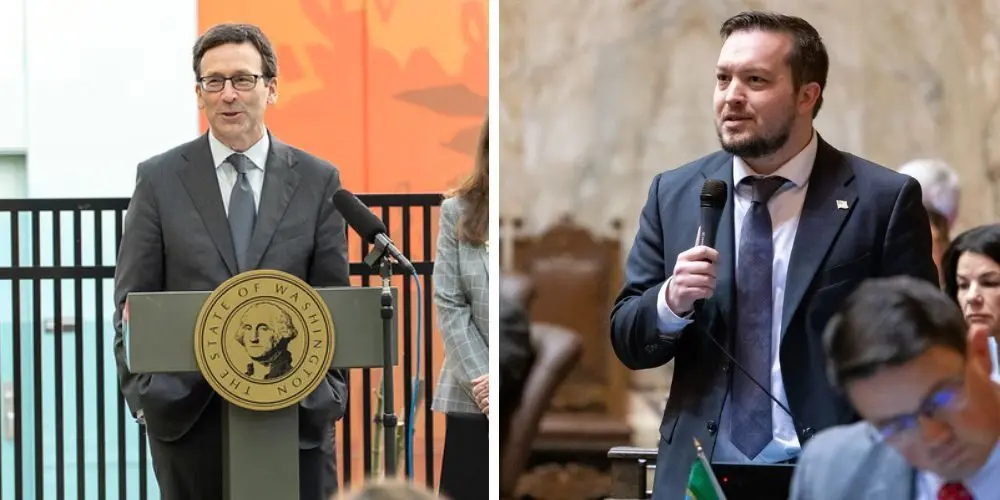
House Republican budget leader Rep. Travis Couture, R-Allyn, slammed the governor’s newly released supplemental budget Thursday, calling it a “dangerous cheat” that relies on spending increases and accounting maneuvers while suspending the state’s balanced budget requirement.
Couture said the proposal expands state government by $1.1 billion, pushes total spending beyond $79 billion, and fails to address the underlying causes of an estimated multibillion-dollar shortfall.
While WA Democrats are pushing an income tax, Republicans are proposing a budget that doesn't raise taxes, keeps all the core essential critical services intact & reduces billions of waste in government.
– Rep @TravisSCouture pic.twitter.com/WCGbx8TASk— Ari Hoffman (@thehoffather) December 29, 2025
“When the governor released his supplemental budget today, we honestly thought it was a prank,” Couture said in a statement. “It’s more of the same reckless behavior — spend more now, worry later.”
But Couture also expanded on those concerns in a wide-ranging interview on The Ari Hoffman Show on Talk Radio 570 KVI, warning that Democrats are laying the groundwork for sweeping tax increases.
“I’m expecting… the governor is gonna come out with, ‘an all cuts budget,’” Couture told host Ari Hoffman, “but I think it’s gonna look intentionally ugly to pave the way into scaring people into more tax increases, including income taxes, payroll taxes, wealth taxes, and probably a host of more.” He added: “As you’ve probably already seen, they plan on a buffet of new taxes.”
Focus on the balanced budget rule
At the center of Couture’s criticism is the budget’s approach to Washington’s long-standing balanced budget rules, which require state lawmakers to pass budgets that balance not only in the short term but over a multi-year outlook.
Couture argued that weakening or suspending the requirement does not solve fiscal problems, but merely delays them.
Rep @TravisCouture discusses how Washington Democrats are spending money on "laser hair removal for transgender inmates and Rain City Jacks" while "cutting from single mothers on the edge of poverty and stealing their child support." pic.twitter.com/kzHGX3AEZI
— Ari Hoffman (@thehoffather) December 29, 2025
“That rule exists to stop politicians from lying to themselves,” he said. “Suspending it doesn’t fix anything — it just hides the problem on paper and dumps the cost on taxpayers later.”
He pointed to recent comments from Lt. Gov. Denny Heck, who warned that eliminating the four-year balanced budget outlook could jeopardize the state’s financial stability. Couture also said credit rating agencies have issued similar cautions in past years.
Rainy day fund concerns
Couture also criticized the governor’s plan to draw nearly $1 billion from the state’s rainy day fund, arguing that Washington already maintains one of the smallest reserve cushions in the country.
“That fund is supposed to be for real emergencies, like flooding and wildfires,” he said, “not for covering up years of overspending.”
He warned that draining reserves now could leave the state exposed during the next downturn.
“This is not an emergency,” Couture said. “Revenues didn’t collapse — discipline and leadership did.”
Claims of “accounting tricks” and service impacts
In his statement, Couture alleged that the governor’s budget depends on short-term fixes rather than structural solutions. He said it relies on “accounting tricks,” shifts money from dedicated accounts, uses one-time funds for ongoing programs, and repositions funding — including school construction dollars — to cover budget gaps.
Couture argued the approach could ultimately harm services, citing reduced child care assistance, delayed care for seniors, constraints on support for working families, and the end of certain tax breaks.
GOP rolls out “Affordability First” framework
Alongside his criticism, Couture promoted a separate House Republican budget framework he released last week — a plan he said is designed to help working Washingtonians without raising taxes.
Dubbed the “Affordability First” budget plan, the framework proposes no new or higher taxes and aims to address what Couture called years of “unsustainable spending” that have contributed to an estimated $4.3 billion budget shortfall.
“For working Washingtonians, the math just doesn’t work anymore,” Couture said. “Groceries cost more. Housing costs more. Child care costs more. But Olympia continues to spend more and deliver worse results.”
In his KVI interview, Couture framed the plan as both a fiscal counterargument and a political contrast.
“What we’re proposing is a budget that does not raise taxes, keeps all the core essential critical services intact,” he said. “It doesn’t cut any services. It just reduces the bloat and waste in government.”
He went further, calling the plan a proof-of-concept that the state can close gaps without the kind of broad new taxes that have been floated by Democrats.
“As it turns out, Ari, you could do that,” Couture said. “You could cut $4 billion out of our state government tomorrow, and not raise taxes and not have to cut… essential services from people who actually need us the most.”
Couture described the framework as “a budget for the working class,” and said it includes structural changes aimed at preventing what he called recurring deficit spending.
“It does a lot of structural fixes to our budgeting process,” he said, “so that we don’t continuously see run-on deficits, billion-dollar deficits every single year.”
Where the savings would come from
According to Couture, the plan identifies $3.7 billion in savings over four years through spending reductions, efficiencies, and eliminating lower-priority programs. He said it is intended to protect core services, avoid cuts to K-12 classrooms, and maintain benefits and service delivery.
The framework also seeks to restore or bolster funding for programs that Couture said have been reduced or underfunded, including:
- Medicaid services
- Food assistance for vulnerable residents
- Wildfire prevention
- Infant care for drug-exposed newborns
- Law enforcement hiring
Couture said the current budget has leaned too heavily on one-time funds, delayed obligations, and revenue assumptions that did not materialize.
“Washington has spent more than it expected to collect for four straight budgets,” he said. “That’s not sustainable for the people of Washington state, and it shouldn’t be how government operates.”
In the radio interview, Couture pointed to what he described as administrative bloat — especially in higher education — as a major cost driver.
“What we’re really looking at is reducing the size of the Washington state bureaucracy,” Couture said. “We’re looking at cutting out some of the upper and middle management… especially in our higher education system.” As one example, he singled out The Evergreen State College: “Evergreen has a four-to-one staff-to-student ratio. That’s insane.”
He also argued the state can restore health care services while still shrinking bureaucracy.
“Democrats made [mistakes] in just the last session,” Couture said, referencing cuts he described as “a billion dollars out of Medicaid for poor Washingtonians’ health care.” He added: “I’m able to fix Medicaid in our state while still cutting down the size of government… so that we don’t need tax increases.”
Proposed reforms: spending limits, tax relief, and audits
Couture’s plan includes several structural reforms aimed at tightening long-term budgeting practices, including:
- Restoring spending limits tied to inflation and population growth
- Implementing zero-based budgeting, requiring agencies to justify expenses from the ground up
- Using independent audits to identify and eliminate waste
“One of the key things that it does… is it enacts a spending cap,” Couture told KVI. “So you can’t spend more than inflation and population. I know it’s a crazy concept.”
Couture also argued that prior surpluses were squandered and proposed a new mechanism to return excess revenue to taxpayers.
“We had a $15 billion surplus during COVID that was all completely wasted,” he said. Under the Affordability First framework, after funding reserves, excess revenue would flow into what he called a “taxpayer relief account” for broad-based relief. Couture said that if the policy had been in place since the 2013 budget biennium, “taxpayers in Washington state would have received $15 billion… dollars in tax relief in this amount of time.”
He said affordability pressures have reached a breaking point.
“One of the most unaffordable states in the nation — gas, groceries, rent, insurance, childcare, energy, you name it,” Couture said. “People are suffering, and we need a budget that actually works for people.”
On accountability, Couture said zero-based budgeting is critical: “That means every dollar gets accounted for, within state agencies.”
A messaging fight heading into the Legislative session
Couture also acknowledged what he sees as the biggest challenge ahead: getting the message to voters before Democrats define the debate.
“Washingtonians don’t know Republicans’ good ideas if we don’t spread the word,” Couture said, arguing that “the left media is not on our side.”
He said the strategy will differ from past efforts because Republicans are releasing the framework before the session begins, rather than midway through.
“We’re hitting it before session,” Couture said, “contrasting it directly with the governor’s budget… and then throughout the process, the Democrats’ budget.”
He encouraged supporters to share the proposal and review its executive summary online, calling the document “marketable” and designed to be widely circulated.
“The only way we can win,” Couture said, “is if we share this with our friends, our families, our neighbors, and say there is a different way forward.”
Looking ahead
The debate over Washington’s fiscal direction is expected to intensify as lawmakers head toward the 2026 legislative session, which begins Monday, Jan. 12.
Couture framed the choice as one between expanding government commitments through what he calls temporary fixes — or adopting a tighter approach focused on affordability and accountability.
“Washingtonians don’t get to suspend their budgets when money gets tight,” he said. “State government shouldn’t either.”
“This budget isn’t bold,” Couture added. “It is reckless and unserious — and it sure isn’t affordable.”