The U.S. Department of Justice has sued Washington and several other states over what it says is a refusal to provide voter-registration data that federal law requires states to make available for inspection.
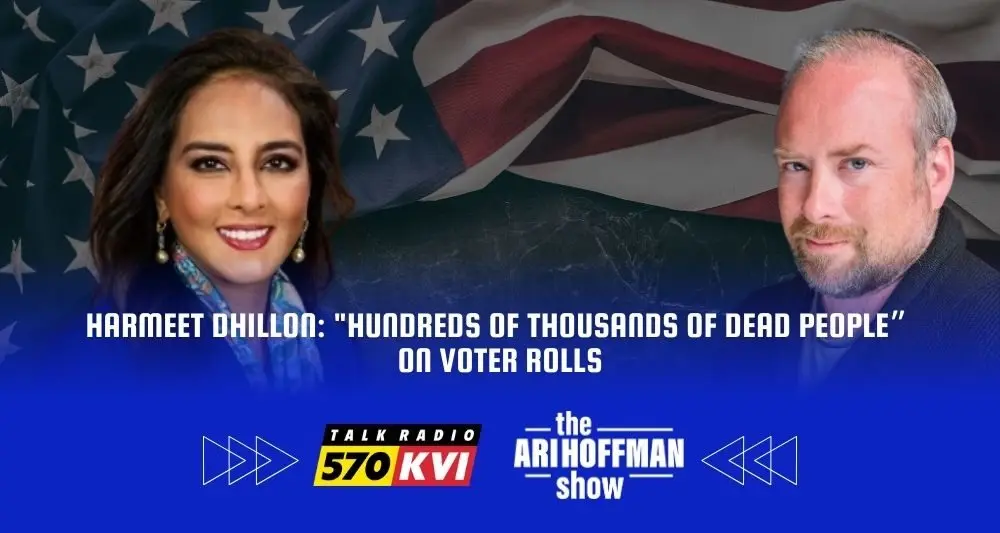
In an interview on The Ari Hoffman Show on Talk Radio 570 KVI, Assistant Attorney General for the Civil Rights Division Harmeet Dhillon said Washington Secretary of State Steve Hobbs is wrongly insisting the DOJ must explain how it intends to use the records before releasing them.
Dhillon argued the federal government’s authority is clear under the Civil Rights Act of 1960, saying the attorney general has an “absolute right” to obtain the information. She described the DOJ’s objective as examining voter-roll data to ensure accuracy and to reduce vulnerabilities that could “dilute” lawful votes in federal elections.
After six states handed over their voter data, @HarmeetKDhillon said:
"They understand that we're here to help them do their jobs & they want to show their homework that they are doing their jobs & I'm grateful for that because it means that we're not going to sue them, cause I… pic.twitter.com/jmpjI9Us4S
— Ari Hoffman (@thehoffather) December 17, 2025
“He does not get to second-guess the federal government fulfilling federal law.”
Hobbs has said publicly he is uncertain what the DOJ plans to do with Washington’s voter data. Hoffman pushed back on that concern during the interview, noting that the federal government already handles vast amounts of information through agencies such as the IRS and FBI, and framing the request as a basic audit to confirm voter rolls contain only eligible voters.
Dhillon agreed, saying state officials do not have the option to “second-guess the federal government” as it carries out federal law. “The secretary of state is mistaken,” she said. “He does not get to second-guess the federal government fulfilling federal law.”
She said the review is aimed at identifying records tied to people who are not eligible to vote—such as non-citizens and deceased individuals—and helping states correct their rolls. In her words, the purpose is to “help clean the voter roll,” by examining records to ensure “non-citizens and dead people and so forth are not on the rolls and left open as exploits.”
"Every citizen has a right to know that in a federal election, their vote is being counted only once & only with other American citizens…We found thousands of people on the voter rolls…and hundreds of thousands of dead people." – @HarmeetKDhillon pic.twitter.com/PsP0wFOQin
— Ari Hoffman (@thehoffather) December 17, 2025
Concerns over “motor voter” and verification gaps
Hoffman also pointed to Washington’s “motor voter” style registration environment, arguing it relies heavily on the honor system, where residents can check a box affirming U.S. citizenship without a robust verification process.
Dhillon said Washington is not alone, calling voter-roll maintenance “kind of a national problem.” She added that the DOJ is stepping in because, as she put it, “the states could be doing this themselves, and they’re not. That’s why we’re here.”
Acknowledging the skepticism many conservatives have about federal involvement, Dhillon referenced the famous Reagan line and leaned into it. “I know that’s kind of the joke,” she said. “Ronald Reagan said that the seven scariest words are ‘I’m from the federal government, and I’m here to help.’ But… we are here to help.”
DOJ claims large-scale roll errors in early review
Dhillon said the department has reviewed tens of millions of records so far and found what she described as significant inaccuracies, including “thousands of people” in the data they say do not belong there and “hundreds of thousands of dead people.”
“We found… thousands of people on the voter rolls and 50 million—almost 50 million—records we’ve reviewed so far,” she said. “And hundreds of thousands of dead people.”
Hoffman offered local examples he says illustrate the problem, including ballots arriving for people who have moved away or household members who are not eligible, and described the “inactive voter” category as a potential blind spot where outdated registrations linger.
Dhillon characterized these issues less as “loopholes” and more as administrative neglect. “I don’t think it’s a loophole so much as just sloppiness,” she said, describing voter-roll management as “unglamorous” work where “the data’s unwieldy” and attention to detail can be lacking.
She also pointed to political and legal pressures on election administrators, saying that some advocacy groups sue when states remove registrations. “Some liberal group—the ACLU, League of Women Voters—is going to sue you if you take people off the voter roll,” she said. “So I get it… the path of least resistance is just have bloated, sloppy voter rolls.”
Six states complied; more lawsuits promised
According to Dhillon, six states have already turned over their data to the DOJ. She said those states view the request as federal support that can help them “do their jobs” and demonstrate they are maintaining accurate voter lists by showing “their homework.”
But she signaled that states that refuse will face litigation. “I’m grateful for that,” she said of the states that cooperated, “because it means that I’m not having to sue them, because I am going to sue everybody else who doesn’t give me their data.”
She added that the department intends to press forward broadly: “This job is going to get done under this administration,” she said. “Ultimately, every state’s going to give us their data, or we’re going to sue them.”
What happens next in Washington’s case
Dhillon laid out a familiar timeline for what she expects in Washington: intervention attempts by outside advocacy groups, a motion to dismiss by the state, and then hearings in which a judge determines whether the DOJ is entitled to the requested records—followed by appeals regardless of the outcome.
“Next up in the process is probably… liberal groups moving to intervene in this lawsuit,” she said, predicting “a motion to dismiss by the state,” and then, “weeks or months down the road,” a hearing “involving a judge determining… who gets these documents.” After that, she said, “There’s inevitably going to be an appeal.”
She also said the approach is consistent across jurisdictions. “Same cookie-cutter in 18 different states,” she said, adding that the DOJ has “a few more that we’re pursuing.”
No public “lists,” but interagency comparisons underway
Near the end of the interview, Hoffman asked whether DOJ efforts are coordinated with agencies like DHS or ICE—particularly if the data review flags individuals who may be unlawfully present.
Dhillon rejected the idea of publicizing names. “No, we’re not going to be releasing lists of people for vigilantes to go after,” she said. “That’s probably not a great idea from a… law enforcement perspective.”
Instead, she said the DOJ is cross-checking data internally and feeding results back to states so they can update rolls. “We are certainly comparing data we’re getting with… other federal government agencies,” she said, adding that DOJ is “letting states know what we’re finding so that they can take people off the voter roll.”
Dhillon framed the effort as a cooperative loop: “This is a two-way process,” she said. “They give us data, we help them. We show them what we did with it and what we found, so they can help clean up the voter roll. That’s really the whole point of this exercise.”
Dhillon closed by reiterating that the goal is straightforward: cleaner voter rolls, fewer vulnerabilities, and elections in which each eligible citizen’s vote is counted “only once” and only alongside other eligible voters.