As floodwaters surged across Western Washington, some public officials and media coverage quickly framed the destruction as a warning about climate change—and an argument for more government action.
But Washington already has a major climate spending program in place. And the state’s own accounting of how those dollars have been used so far shows a striking mismatch between what lawmakers said the money was for and what it has funded in practice.
Why didn't climate taxes stop the floods Democrats are blaming on 'climate change'?
"We were promised that adopting the Climate Commitment Act, the CO2 tax, would mitigate the impact of flooding that people argue was caused by climate change…But if you want to mitigate that,… pic.twitter.com/xQ23w0rznV
— Ari Hoffman (@thehoffather) December 17, 2025
The Climate Commitment Act (CCA), Washington’s cap-and-tax carbon program, took effect in 2023 and has collected more than $4 billion. In the first two years of the program, more than $3 billion was appropriated, and the state reports that more than $1.5 billion has already been spent. But, if the CCA was meant to help Washington prepare for climate-driven flooding, the early results don’t show it.
Flooding was part of the promise. It wasn’t the priority.
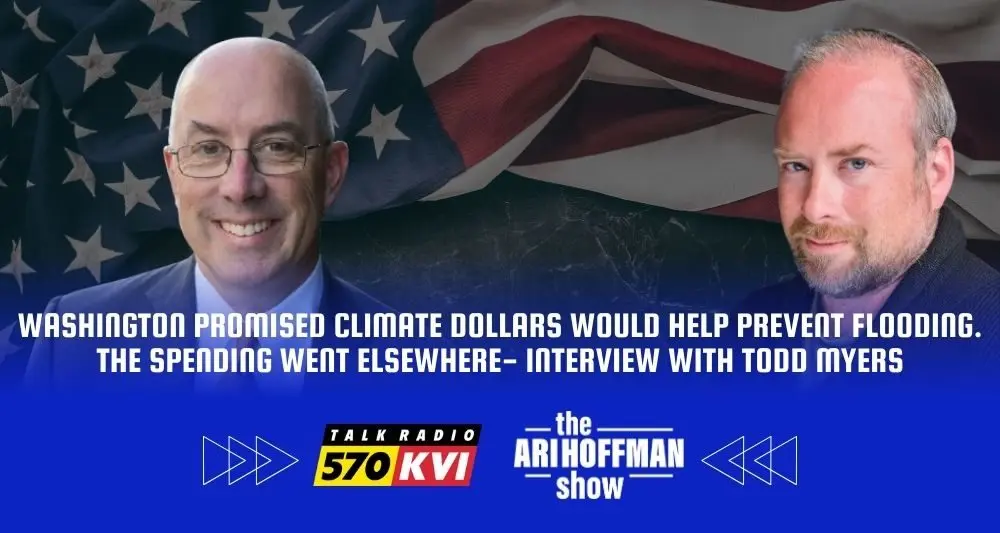
On Talk Radio 570 KVI’s Ari Hoffman Show, Washington Policy Center Vice President of Research Todd Myers responded to the latest flooding by pointing to the gap between the state’s messaging and its budgeting.
“I was told that if a whole bunch of my tax dollars were collected by Washington state, it would stop climate change—and it would specifically stop things like flooding,” host Ari Hoffman said. “Now the Seattle Times says that these floods are being caused by climate change… So how come there’s a whole bunch of water everywhere?”
Myers said, “Warmer air carries more water and more water means more rain,” acknowledging that this can increase flood risk, but emphasized that if officials claim climate policy is necessary to reduce flooding, then flood prevention should be a clear funding priority.
“If you want to mitigate that, then you need to spend money on things that actually reduce the risk of floods.”
Why didn't Washington spend the money that was supposed to mitigate the impacts of flooding on mitigating the impacts of flooding?
"1/2 of 1% of the money spent so far has been on flooding…over the last 2 years, we have spent $15 million on bicycle education for elementary &… pic.twitter.com/mHyo07MMNH
— Ari Hoffman (@thehoffather) December 17, 2025
The state spent $1.5 billion. Only about $7 million went to flooding.
According to the state’s list of funded projects, Myers said that of the more than $1.5 billion already spent from climate accounts, only about $7 million, roughly one-half of one percent, has gone toward addressing flooding.
And even that small amount often didn’t go to shoring up levees, upgrading stormwater systems, restoring floodplains, or improving river infrastructure. Much of it went to staffing, administration, and planning.
Myers pointed to several of the biggest items in the state’s own project list:
- $1.5 million for Whatcom County’s Floodplain Integrated Planning process
- $900,000 for staff costs to administer the Transboundary Flooding grant program
- $406,797 to train “young adults” to implement restoration and flood prevention projects
Some dollars did support direct improvements, including roughly $350,000 for a flood control channel in Walla Walla and nearly $150,000 for flood process improvements on the Quillayute River. But the totals remain small compared to the scale of flooding risk, and compared to what the state has spent on other, unrelated items.
Climate funds went to projects unrelated to flooding—or even to emissions
Myers said what stands out most is not just how little went to flood risk, but how much went to projects with little or no connection to flooding, resilience, or even measurable climate benefit.
One example: bicycle education.
“Over the last two years, we have spent $15 million on bicycle education for elementary and middle school students using CO2 tax money,” Myers said. “We have spent more than twice as much on bicycle education… than we have on mitigating the impacts of flooding.”
He also noted that at least some of that funding went to the Cascade Bicycle Club, which he described as a progressive advocacy organization that lobbies on policy and elections.
“Not only does it go to something that is silly, it also goes to a political ally,” Myers said.
He argued the same pattern appears in other big-ticket spending choices—such as early funding for ferry electrification, and state dollars committed to a hydrogen hub effort that he said was later eliminated in federal budgeting.
Beyond the projects themselves, Myers criticized the state’s public claims about effectiveness, alleging that some of the emissions-reduction estimates used to promote CCA spending are implausible.
“The state put out a report… saying… they’re very effective in terms of how much it cost to reduce CO2,” Myers said. “When I saw that, I was like, that can’t be right… They simply made up some of the numbers.”
If flooding is the justification, spending should match the risk
The broader issue is one of credibility.
The state’s climate messaging frequently invokes worsening floods, wildfires, and other extreme weather as reasons to expand carbon taxes and climate spending. Yet when floodwaters rise, the public is told more funding is necessary, even though the money already collected has largely been routed to other priorities.
Myers’ argument is that Washington does not have a lack of revenue. It has a lack of prioritization. “We have so many infrastructure problems… there are a lot of levees and a lot of places that probably could be shored up,” he said. “That isn’t just another reason that what you have to do is make sure that the money you spent is spent well and that you have to prioritize it.”
He summed it up this way: “The flooding… will be used as a justification for more climate action, even as the money that we already have is not being spent to reduce these kinds of harms.”