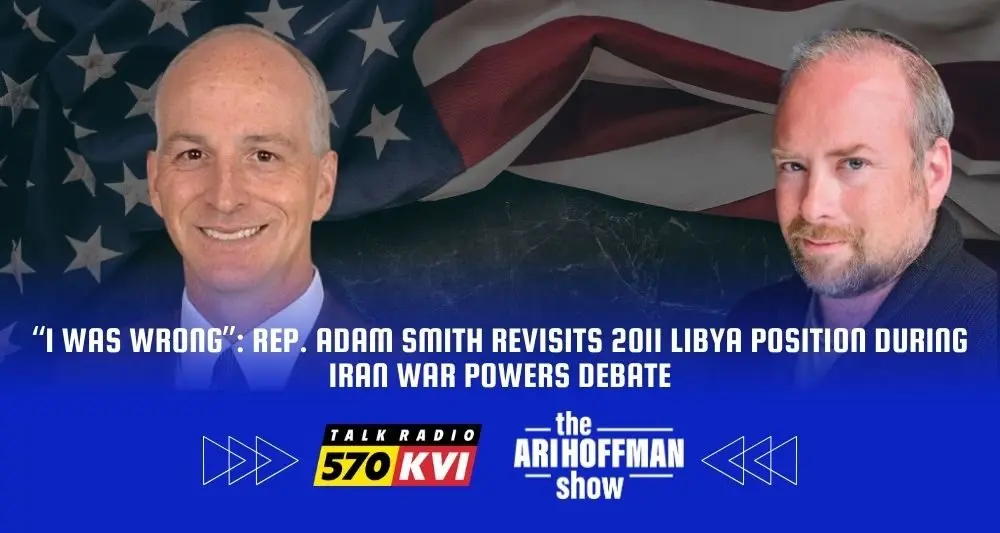
Rep. Adam Smith joined The Ari Hoffman Show to discuss the war in Iran and the debate over President Donald Trump’s authority to launch military action without congressional approval.
Smith said he had just come from the House floor, where lawmakers voted on a measure aimed at requiring Congress to approve military action against Iran.
"I was wrong."
Rep. Adam Smith joined the show to discuss the war in Iran & President Trump's authority. When I asked about his 2011 opposition to resolutions that would have limited Obama's war powers against Libya & Gadhafi, he said, "I was wrong."
WATCH the debate here pic.twitter.com/cpJf7Q6n99
— Ari Hoffman (@thehoffather) March 6, 2026
“The vote was to basically require Congress to approve the war in Iran,” Smith said, adding that while the measure was not expected to pass and was more of a statement than a binding restriction, he believed Congress should have to authorize such a conflict. “I think it should. So I voted yes.”
That set up the larger question at the center of the interview: whether Smith’s current position on presidential war powers is consistent with his past views.
Hoffman asked Smith about a June 3, 2011 statement in which he applauded debate in Congress over the Libya conflict but opposed resolutions that would have limited President Barack Obama’s ability to continue military operations against Moammar Gadhafi. At the time, Smith argued those resolutions would tie the president’s hands, undermine the mission, and send the wrong message to U.S. allies.
Asked how he squares that position with his current support for limiting Trump’s authority to wage war against Iran without Congress, Smith gave a strikingly candid answer: “I was wrong.”
Smith said his thinking changed because of what the United States experienced in Libya, Iraq, and Afghanistan.
“What I learned from Libya, Iraq and Afghanistan is an excessive belief that the point of a gun can solve those problems — and not, in fact, make them worse — is a mistake,” Smith said. He added that after years of watching military interventions unfold, he no longer believes force can reliably deliver the precise political outcome policymakers want. “Excessively relying on the military to go out in the world and solve problems frequently makes it worse, comes at enormous cost, and is simply not as easy as it looks.”
The interview then turned to whether diplomacy with Iran has actually worked. Hoffman argued that the United States and its allies have spent decades negotiating with Tehran while the regime continued stalling for time, funding terrorism, and pushing its nuclear ambitions forward.
Smith responded by drawing a distinction between Iran’s nuclear program and the regime’s ballistic missile development and support for terrorist proxies.
“Let’s just take the nuclear weapon,” Smith said. “Actually, negotiations worked on the nuclear weapon. They got rid of their highly enriched uranium. They agreed to allow inspectors in.”
Hoffman pushed back, arguing that Israeli sabotage and covert action did more to slow Iran’s nuclear program than diplomacy ever did. Smith rejected that outright.
“That’s simply factually incorrect,” he said. He acknowledged what he called the major weakness of the Iran nuclear deal, saying it failed to address Tehran’s ballistic missile program and its support for groups like Hezbollah, Hamas, and the Houthis. “That is a fair criticism,” he said. “But on the nuclear program itself, they adhered to that agreement. They allowed inspectors in and they took their enriched uranium down.”
When pressed on why Iran later resumed enrichment under Joe Biden while sanctions were eased and assets were unfrozen, Smith said he was not interested in defending Biden but insisted the key turning point was the collapse of the original nuclear agreement.
“I am the last person on God’s green earth to defend Joe Biden,” Smith said. “That’s not my point.” His point, he said, was that “once we tore up the JCPOA, they went back to nuclear development.” According to Smith, Iran then ramped enrichment back up to 60 percent.
Smith repeatedly returned to the broader lesson he says he has learned over decades of U.S. conflict in the Middle East: even when Iran poses a real threat, war is not automatically the right answer.
He described Iran as a serious regional danger, a state sponsor of terror, and a country creeping toward nuclear weapons capability, but argued that launching a wider war could create consequences far beyond the stated objective.
“Launching this war in this way has set off all manner of eruptions throughout the Middle East,” Smith said. “At the end of it, are we going to be that much different? It does not look like the regime is falling. They will reconstitute and rebuild.”
Smith also argued that recent military action risks expanding an already volatile conflict into something even broader, with no clear end state and no obvious military objective beyond what he said had already been achieved in the initial fighting. In his view, Americans should be deeply skeptical of claims that another war in the Middle East will be quick, clean, or decisive.
Hoffman challenged that argument by pointing out that Iran’s regime has spent nearly half a century killing Americans, destabilizing the region, and targeting its own people. Whatever diplomatic efforts have been attempted under Republican and Democratic presidents alike, the regime remains in power and continues to back terror. From that perspective, the question is obvious: if negotiations, sanctions, cash payments, and international agreements have failed to change Iran’s behavior, what option is left?
Smith said he does not accept the argument that diplomacy “didn’t do anything.” He also contended that many of the American deaths tied to Iranian-backed forces occurred in the context of the Iraq War, which he said created the conditions for much of that violence.
“The bulk of the Americans that have been killed by the Iranians were as a result of the Iraq war that we kicked off in 2003,” Smith said. He added that he still holds Iran accountable for supplying militias and supporting attacks with IEDs, but argued that American policymakers should also recognize the role U.S. decisions played in creating the larger conflict.
In the end, Smith maintained that Iran can and should be contained, but without stumbling into a larger regional war that could cost far more than its advocates expect.
“I just don’t think that war is always the answer,” Smith said. “I think there is a way to contain this threat without stumbling into this war that is going to be very, very costly.”
Even as he criticized the policy and questioned the wisdom of expanding the conflict, Smith closed with a note of support for the men and women in uniform now carrying out the mission.
“Let me be clear,” Smith said. “I support the troops who are fighting this fight, and my thoughts are with them. They’re in a very dangerous situation and we need to all be united on that front.”