

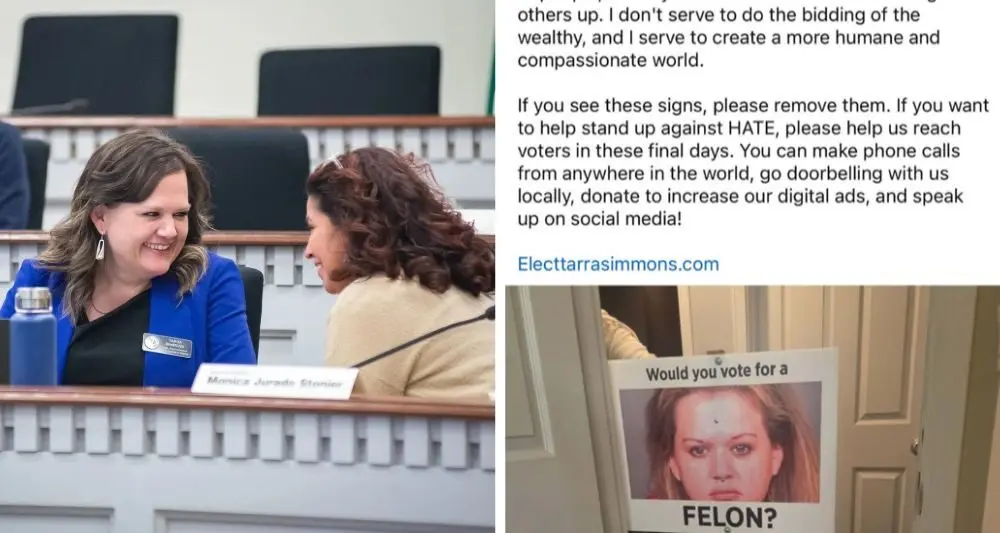
Democratic Washington state Rep. Tarra Simmons’ reelection campaign is urging supporters to remove signs displaying a booking photograph of her and asking, “Would you vote for a FELON?” The appeal comes as Simmons faces another ethics hearing over allegations that she used her office to benefit a former employer.
“If you see these signs, please remove them,” the Re-elect Tarra Simmons campaign posted on Facebook, alongside a photograph of the sign.
Ex-con Democratic Rep. Tarra Simmons is encouraging her supporters to steal people's yard signs
Is she hoping for yet another ethics complaint? pic.twitter.com/cmjSL0korx
— Ari Hoffman (@thehoffather) November 1, 2026
Under Washington law, removing or defacing lawfully placed political signs without authorization is a misdemeanor. Each sign constitutes a separate violation, punishable by up to 90 days in jail, a $1,000 fine, or both. The campaign’s request did not distinguish between lawfully placed signs and those placed without permission.
“The lengths people have gone through to take me out is sickening,” the post stated. “The frivolous complaints, the $500K in Corporate spending, the manufactured lies. Now putting up these signs around my district?”
The campaign portrayed the signs as “HATE” and asked supporters to call voters, knock on doors, donate, and advocate online. The signs reference Simmons’ criminal history, though her felony convictions were vacated in 2023.
The characterization of complaints as “frivolous” follows three Legislative Ethics Board findings against Simmons that resulted in $52,457.98 in penalties and costs.
An October 30 order schedules another hearing for May 10–11, 2027, over allegations that the Bremerton Democrat intervened in a contract dispute to benefit the Equity in Education Center, her former employer.
The board found reasonable cause to believe Simmons violated the prohibition on special privileges by “using her position to attempt to convince Commerce to resolve the dispute in EEC’s favor.” That is a preliminary determination, not a final finding of a violation.
Commerce’s ethics adviser filed the complaint October 6, 2025. The board found reasonable cause on March 30, 2026.
According to the order, EEC received a $4.7 million Digital Navigator Services grant in 2021 and another contract worth $20.2 million in 2023. The program provided devices, subscriptions, and help accessing digital services.
After a state audit identified problems, Commerce paused payments to EEC because its documentation was insufficient to justify reimbursement. EEC disputed the decision and objected to the agency’s choice of an internal official to review it.
EEC director Sharonne Navas requested a legislative work session. Committee Chair Cindy Ryu initially declined, but Simmons subsequently sought an informal briefing.
An unrecorded “listening session” occurred August 26, 2025. Ryu told investigators the entire meeting concerned EEC’s dispute with Commerce, which declined to attend while its review remained underway.
Simmons expressed concern about leading the session because she had worked for EEC and proposed that Ryu chair it. Simmons’ legislative assistant distributed invitations.
Afterward, Simmons questioned Commerce’s choice of reviewer and suggested the Office of Equity could help secure a neutral third party. A follow-up session was canceled after Commerce filed the complaint.
The order also identifies two reimbursement vouchers indicating Simmons was paid under EEC’s Commerce contract. Navas told investigators her inclusion was an error, and those funds did not pay her.
Simmons denies wrongdoing. She told the Kitsap Sun she rejected a $500 settlement because she disputed its factual assertions, was trying to understand problems affecting nonprofits, and questioned the announcement’s timing before the election.
The pending case follows separate findings involving the same organization, previously known as the Equity in Education Coalition. As KVI reported in August, the board found violations involving a budget provision benefiting Simmons’ employer, intervention to preserve its funding, and attempted retaliation against a complainant.
The board imposed three maximum $5,000 penalties. Its final order added $37,457.98 in costs. Three other allegations involving proposed nonprofit employment for a friend, associated campaign money, and her outside employment were dismissed. Simmons has appealed the ruling.
She also acknowledged a separate campaign-finance violation. KVI previously reported that Kitsap County Democratic Party Chair Val Torrens challenged $30,000 Simmons sent from her surplus campaign account to Nevada nonprofit Better Minds Better Communities.
In an April Public Disclosure Commission agreement, Simmons acknowledged the donations were improper because the recipient lacked the required Washington charitable registration. She agreed to a $300 penalty; repayment was not required.
Other complaints were dismissed, including one over her efforts to discourage fellow Democrat Daria Ilgen from challenging her and another involving personal Facebook posts.
Simmons also disputed her dismissal from Civil Survival, the nonprofit she co-founded. Its board said in August 2024 that she repeatedly violated policies, berated an employee, and threatened funding and staff employment. Simmons alleged discrimination and wrongful termination.
According to sheriff’s records, in 2001 Simmons invited a man to her Silverdale home, where others beat him with baseball bats and beer bottles, robbed him, and threatened him with a knife. The victim, a 25-year-old military servicemember, reported that both hands were broken and that Simmons ignored his repeated pleas to intervene. She accused him of rape, and he denied the allegation. Simmons was convicted of second-degree assault, followed by five convictions in 2011 involving organized retail theft, unlawful firearm possession, and controlled substances. The Washington Supreme Court later recognized her rehabilitation, and her felony convictions were vacated in 2023.
The latest ethics proceeding could result in a civil penalty of up to $5,000 per violation, plus investigative costs.