


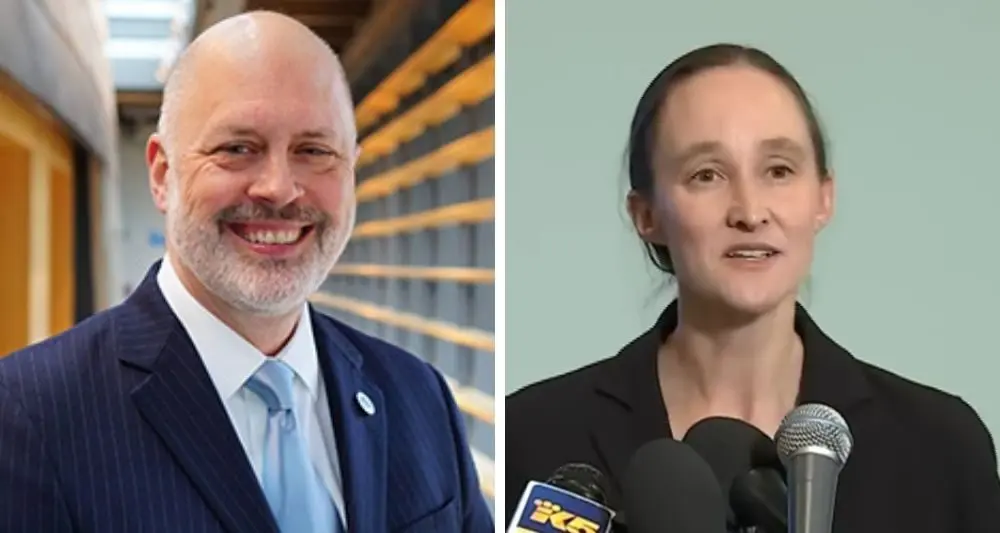
Seattle City Councilmember Bob Kettle is publicly challenging Mayor Katie Wilson over her handling of the aftermath of the deadly Bite of Seattle shooting, while demanding a broader review of the city’s public-safety response that goes beyond a routine after-action report.
Kettle, who represents District 7 and chairs the City Council’s Public Safety Committee, sent Wilson a letter Monday calling for a procedural review of the July 26 mass shooting at Seattle Center, which left three people dead and several others injured.
“The tragedy that recently unfolded during the Bite of Seattle at Seattle Center on July 26 has underscored the need for a procedural review — beyond the expected ‘After-Action Report,'” Kettle wrote.
Kettle said the city needs to examine lessons at both the operational level — including the immediate response and ongoing investigation — and at the broader strategic level.
“Our constituents, the many diverse communities we collectively serve, are entitled to answers,” he wrote.
The dispute became more pointed during Tuesday’s council meeting, when Kettle directly pushed back on Wilson’s claim that she had a “better window” into the response.
“When the mayor says, ‘I have a better window,’ what’s clear here is that she does not have a better window. She does not have a better window than I do. She does not have a better window than probably the majority of the council,” Kettle said.
"When the mayor says, 'I have a better window,' what's clear here is that she does not have a better window. She does not have a better window than I do. She does not have a better window than probably the majority of the council."
Seattle City Council member and chair of public… pic.twitter.com/8nEEcSwbAQ
— Ari Hoffman (@thehoffather) August 12, 2026
The rebuke is significant coming from the councilmember who chairs the committee responsible for public-safety oversight and who said he was personally at Seattle Center for roughly three hours on the night of the shooting.
Kettle previously said he went to the scene after receiving a call from Deputy Mayor Brian Surratt and communicated with the Seattle Police Department, Surratt, Director of Public Safety Alison Holcomb, and other councilmembers. He has released his own timeline of the evening, saying it was intended to provide transparency and a baseline based on what he directly witnessed.
Among the issues Kettle wants reviewed are security at major Seattle venues, police staffing, mutual aid, communications and camera technology.
His letter asks how the city’s “ongoing challenges with staffing, outside support/mutual aid, camera technology, and communication” affected operational coordination and the government response. He also wants officials to examine the use of Crime Prevention Through Environmental Design, or CPTED, at major venues and events.
The questions come amid a separate fight over Wilson’s decision to pause part of Seattle’s surveillance-camera program.
On Aug. 3, operators and organizers representing some of Seattle’s largest stadiums, arenas, festivals and public gathering spaces wrote Wilson asking her administration to reactivate 22 CCTV cameras in the Stadium District and Pioneer Square that had been connected to the Seattle Police Department’s Real-Time Crime Center.
The group acknowledged that Wilson’s administration had paused the program while conducting a citywide audit of its data-privacy policies, but argued that the recent violence demonstrated that large events remain vulnerable and that police need “every tool at their disposal.”
The signatories also called for additional investment in surveillance cameras in locations that regularly host large-scale events, specifically identifying Seattle Center.
That demand overlaps directly with Kettle’s review. His letter specifically asks what lessons the city can take from the “successful use” of the CCTV program and Real-Time Crime Center in the Stadium District and Pioneer Square.
Kettle also wants the city to look beyond the events of July 26 and examine what he described as an existing pattern of unsolved gun violence involving young people.
“I strongly believe that we need to focus on how this shooting is part of an existing pattern of unsolved gun violence involving our young people, and how this, sadly, is the latest in a long line of tragedies,” Kettle wrote.
The issues raised by Kettle, including how Seattle can better leverage its technology programs, are expected to be taken up by the Public Safety Committee on Sept. 22.
The escalating public-safety dispute comes as Wilson is also facing a recall effort, adding another political challenge for the mayor as her administration faces questions over its handling of crime and the response to the Seattle Center shooting.

