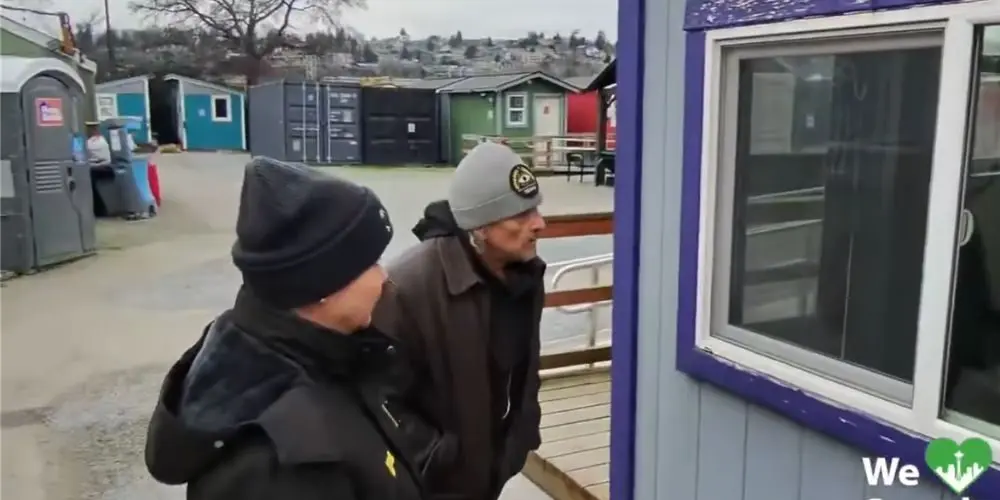

Seattle’s Low Income Housing Institute (LIHI) is defending the use of a “multi-use room” inside one of its taxpayer-funded tiny home villages after We Heart Seattle founder Andrea Suarez released video footage showing a designated drug-use area inside the facility.
The controversy erupted after Suarez toured the Interbay Tiny House Village while visiting a homeless client and documented what she described as a “fentanyl smoking shack” inside the encampment. Suarez later discussed the discovery during an appearance on The Ari Hoffman Show on Talk Radio 570 KVI, alleging that sanctioned encampments across Seattle have quietly become de facto supervised drug consumption sites.
“There are fentanyl smoking rooms in tiny house villages…This is a low-barrier encampment where you can bring in whatever you want—including illegal drugs.”@weheartseattle founder Andrea Suarez was banned from a Seattle tiny home village after exposing rampant drug use pic.twitter.com/0ck0L8GGyn
— Ari Hoffman (@thehoffather) April 1, 2026
“There are fentanyl smoking courts, shacks, rooms, tiny house villages, courtyards, gazebos,” Suarez said during the interview. “I’ve been sounding the alarm for years.”
Now, in response to public backlash over the video, LIHI appears to acknowledge that drug use occurs inside the facility and defended the policy as a form of “harm reduction.”
Don’t hate the player, hate the game. Funding requires low barrier (drugs allowed), and “harm reduction” practices like this dedicated volunteer built tiny home to smoke illegal and lethal Fentanyl. Do the voters know they are paying for this and to be installed in their… pic.twitter.com/nPuMPS72Wm
— We Heart Seattle (@weheartseattle) March 24, 2026
“In regards to the multi-use room, it is available to people for a variety of uses,” Marta Kidane, Community Engagement Manager for LIHI, said in a statement responding to Suarez’s video. The organization explained that the room is used to monitor individuals “experiencing the results of trauma, co-occurring behavioral health issues, including substance use disorder.”
LIHI further admitted that staff may observe individuals during drug-related episodes and intervene when overdoses occur.
“In some cases lives are saved by staff observing and administering Narcan, calling for emergency medical aid, or working to divert or de-escalate a mental health crisis,” the organization stated.
The nonprofit argued that allowing staff to monitor individuals during drug use is necessary because “without the ability for staff to observe and intervene people can injure themselves or overdose and die.”
The statement closely mirrors arguments commonly made in support of supervised consumption sites, facilities where drug users are allowed to consume illegal narcotics under supervision in an effort to reduce fatal overdoses.
Suarez argued during her KVI interview that Seattle officials should simply admit that is what these sites have become. “If we’re going down the path of supervised consumption sites like Vancouver BC or San Francisco, then just call it what it is,” Suarez said. “Let voters decide if they want that.”
The We Heart Seattle founder also alleged that the city’s “harm reduction” model has created environments where drug use is tolerated while intervention is discouraged. “It’s very much harm reduction in every sense of the word,” Suarez said. “Even calling the police is very much frowned upon.”
LIHI also used its response to criticize Suarez directly, accusing her of violating client privacy and “vilifying” homeless residents struggling with addiction and mental illness.
“Regarding an individual not being allowed on LIHI property, we believe that any individual that insists on coming on to LIHI property to antagonize and vilify clients is not welcomed,” the organization said.
LIHI further claimed that some critics of homeless housing programs “have agendas to denigrate people living with disabilities and substance use disorders.”
Suarez, however, maintains that exposing the conditions inside publicly funded encampments is necessary because taxpayers are not being told the truth about how these facilities operate. “These aren’t just homeless folks that need a place to stabilize,” Suarez said during the interview. “These are drug addicts first and foremost, and they need treatment first.”
She told The Ari Hoffman Show in a statement that taxpayer-funded agencies have banned her for “exposing how things looked inside,” and it was her homeless clients and their families who invited her into the facilities.
Suarez also asked that if “harm reduction” is the point of the “multi-purpose room,” how does LIHI apply to practice to those who use drugs inside their own tiny homes?
The debate comes as Socialist Seattle Mayor Katie Wilson and the City Council continue expanding tiny home villages and other low-barrier housing models despite growing concerns from residents over public safety, drug activity, and accountability surrounding taxpayer-funded homelessness programs. Critics argue that the city has effectively created unsanctioned drug consumption spaces under the banner of homelessness services.