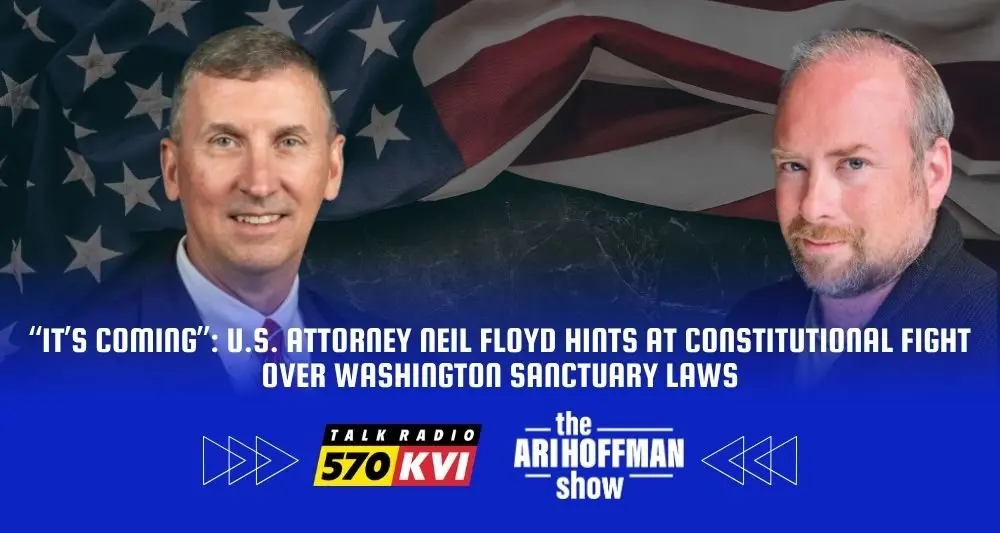
In an exclusive interview on The Ari Hoffman Show on Talk Radio 570 KVI, U.S. Attorney Neil Floyd offered a candid look into the challenges facing federal law enforcement in Washington State — from alleged fraud investigations to sanctuary state policies, Antifa violence, and immigration enforcement.
Floyd, who serves as the top federal prosecutor for the Western District of Washington, described a legal and political environment where federal authorities are often blocked from cooperating with local officials, even when dealing with violent criminals and repeat offenders.
What a U.S. Attorney Actually Does
Floyd began by explaining that the role of a U.S. Attorney is frequently misunderstood.
“At our base level, our job is to prosecute crimes that are brought to us from federal law enforcement investigators,” Floyd said.
He emphasized that federal investigations cannot simply be opened based on rumors or political pressure. Law enforcement must first establish what is known as a “predicate crime” — evidence that a federal crime may have occurred.
“You don’t want the federal government out there just willy-nilly saying, ‘I don’t like this guy, we should investigate them,’” Floyd explained.
Investigating Fraud in Washington
The conversation turned to allegations of fraud involving daycare providers, hospice groups, and other state-funded programs.
Floyd confirmed that federal authorities are examining whether criminal activity occurred amid what he described as a major push under the previous administration to “push money out the door” rapidly.
According to Floyd, investigators are examining not only recipients of state funds, but potentially state officials involved in distributing the money.
“We’re taking a look to figure out whether or not any of the actions on the part of the people receiving the money, the people that were clients of the ones that were receiving the money, or even those in the state that were helping push the money out the door would constitute a federal crime,” he said.
At the same time, Floyd acknowledged the difficulty in distinguishing between flawed policy and outright criminal fraud.
Antifa, Political Violence, and Federal Investigations
Floyd also addressed growing concerns over Antifa-related violence and politically motivated protests in Seattle.
While declining to comment on specific investigations, Floyd acknowledged that federal authorities are closely monitoring extremist groups through open-source intelligence gathering.
“We have been relatively quiet here in Washington, which has been a surprise,” Floyd said. “I don’t expect that to necessarily last.”
He explained that federal authorities are preparing in advance for possible future violence by monitoring communications and organizational activity that is publicly available online.
“You want to be left of bang,” Floyd said, referencing a military term meaning law enforcement should prepare before violence occurs.
The discussion referenced a recent pro-Israel event in Seattle where protesters allegedly blocked attendees from entering a building and assaulted both civilians and police officers. Floyd reiterated his frustration that local authorities often fail to act decisively.
Sanctuary State Policies Creating Conflict
One of the most revealing portions of the interview centered on Washington’s sanctuary state laws and the conflict between federal immigration enforcement and state officials.
Floyd disclosed that after comments from Seattle Mayor Katie Wilson regarding immigration enforcement, he requested a meeting with city and state leaders. Instead, he found himself meeting with Governor Bob Ferguson, Attorney General Nick Brown, the deputy mayor, and others who questioned him about possible federal immigration operations.
Floyd said he attempted to find areas of cooperation that would reduce conflict and improve public safety.
“I said no, I’m not talking about violating any laws,” Floyd explained. “There’s just got to be some areas of cooperation.”
According to Floyd, state officials refused.
“You’re Forcing Them Into the Community”
Floyd argued that Washington’s refusal to cooperate with Immigration and Customs Enforcement (ICE) actually increases encounters between immigration agents and the general public.
He outlined two competing enforcement models.
In one scenario, ICE officers lack access to local jail systems and must search neighborhoods for wanted individuals, often relying on outdated addresses and incomplete information. In the other scenario, officers can coordinate with local jails to take custody of individuals already arrested for crimes.
“If you give me access to the jail like they’ve done in Minneapolis now, like they’ve done in Minnesota, then I’m going to take those same hundred officers and put them in state jails picking up people that have already been arrested,” Floyd said.
Instead, Floyd argued, Washington’s policies force ICE officers into broader community operations that critics often condemn.
“When you break down that system, you’re forcing them into the community to do exactly what you don’t want them to do,” he said.
Violent Criminals Being Released
Floyd expressed particular frustration over cases involving violent offenders who are in the country illegally but are released rather than transferred to federal custody.
He cited examples involving child rape suspects, repeat DUI offenders, and individuals previously deported from the United States.
One case involved an illegal immigrant accused of raping a child in 2008 who had previously been removed from the country and later returned illegally.
“If it wasn’t for my federal arrest warrant because he had been previously removed, he would have been released on the street after having raped a child and still here illegally,” Floyd said.
He also referenced illegal immigrant truck drivers operating without proper commercial licenses, including cases tied to fatal crashes involving a Washington State Patrol trooper and a young father.
Despite these cases, Floyd said state officials still refuse broader cooperation with federal immigration authorities.
Constitutional Challenges May Be Coming
Toward the end of the interview, Floyd hinted that legal challenges against Washington’s sanctuary policies could be on the horizon.
“There’s a lot of things that are going on that frankly are just against the Constitution,” Floyd said. “We’re looking into that.”
While careful not to elaborate further, Floyd suggested that future action may be forthcoming.
“It’s coming is the short version,” he said.