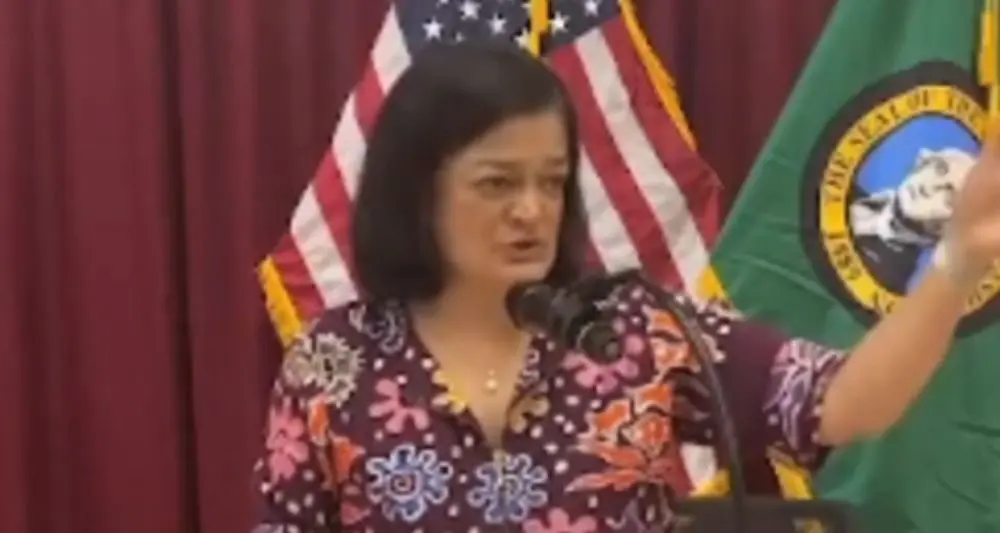
Congresswoman Pramila Jayapal (D-WA) revealed this week that she has been coordinating with foreign diplomats to help Cuba secure oil shipments in an apparent effort to blunt sanctions imposed by President Donald Trump, remarks that are likely to raise questions about whether a sitting member of Congress is undermining US foreign policy while advocating relief for a communist regime designated by Trump as a state sponsor of terrorism.
Speaking during a town hall event, Jayapal admitted she had been in direct discussions with ambassadors from Mexico and other Latin American nations about getting oil into Cuba despite the Trump administration’s intensified sanctions campaign.
Rep. Pramila Jayapal (D-GAZA) announces she has been working with foreign countries to supply oil to Cuba, to help the communist regime to specifically defy President Trump.pic.twitter.com/IyMZrSDi61
— Ari Hoffman (@thehoffather) May 6, 2026
“I was in conversations with the ambassadors from Mexico and some other places, other countries in Latin America, trying to figure out how to get oil there,” Jayapal said, adding that Russia had pledged to send another tanker to the island nation.
The comments come as the Trump administration has escalated pressure on Cuba through sweeping economic penalties designed to cut off the regime’s access to foreign energy supplies. In January 2026, President Trump signed an executive order imposing tariffs on countries that provide oil to Cuba, arguing the measures were necessary to protect “US national security and foreign policy from the Cuban regime’s malign actions and policies.” The administration tightened those restrictions further on May 1 by targeting foreign banks and firms doing business with Havana.
Jayapal, however, characterized the sanctions as “economic bombing of the infrastructure of Cuba,” claiming they were “illegal” and “against international law.”
But on Tuesday, Secretary of State Marco Rubio, whose parents immigrated from Cuba, directly dismantled the narrative being pushed by Jayapal and progressive Democrats during a White House press briefing.
“On Cuba, oil blockade on Cuba, there’s no oil blockade on Cuba per se,” Rubio said. “Here’s what’s happening with Cuba, okay. Cuba used to get free oil from Venezuela. They would take like 60% of that oil and resell it for cash. It wouldn’t even go to benefit the people.”
BREAKING: Secretary of State Marco Rubio hits back at claims of a U.S. oil blockade on Cuba:
"Here's what's happening with Cuba, okay? Cuba used to get free oil from Venezuela. They would take like 60% of that oil and resell it for cash. It wouldn't even go to benefit the… pic.twitter.com/ioSWrGqDhx
— Fox News (@FoxNews) May 5, 2026
Rubio explained that the issue facing Cuba is not American policy, but the collapse of the communist regime’s dependency on subsidized foreign oil.
“So the only blockade that’s happened is the Venezuelans have decided, we’re not giving you free oil anymore,” Rubio said. “And you can only imagine nowadays, the way oil prices are, no one’s giving away free oil, much less to a failed regime.”
He continued: “The problem of Cuba is worse, okay. Their economic model doesn’t work, doesn’t work. And the people who are in charge can’t fix it. And the reason that I can’t fix it is not just because they’re communists, that’s bad enough, but they’re incompetent communists.”
Rubio’s remarks sharply undercut Jayapal’s framing that the United States is singularly responsible for Cuba’s economic collapse. The secretary instead pointed to decades of failed socialist governance and corruption inside the Cuban regime itself.
Jayapal has long opposed the US embargo on Cuba and led a congressional delegation to the communist country in April, where she demanded an end to what she called an “illegal fuel blockade.” Trump reversed many Obama-era efforts to normalize relations with Havana during his first term, redesignating Cuba as a State Sponsor of Terrorism and citing the regime’s support for authoritarian governments and anti-American actors throughout Latin America.
The controversy also exposes what opponents describe as glaring hypocrisy in Jayapal’s foreign policy positions. While she has repeatedly voiced support for Ukraine amid Russia’s invasion, she simultaneously acknowledged depending on Russian oil shipments to prop up the Cuban regime. Moscow’s energy exports remain one of the Kremlin’s primary sources of funding for the war in Ukraine.
The Seattle congresswoman has also faced criticism in recent years over her alignment with activist movements that have targeted American corporations and institutions through radical left-wing organizing campaigns. Starbucks, headquartered in Washington state, became a frequent target of activist pressure campaigns tied to anti-Israel protests and “resistance” organizing efforts critics argued promoted rhetoric sympathetic to extremist causes and terror-linked narratives.
Now, Jayapal is facing scrutiny again—this time for appearing to coordinate with foreign governments to circumvent sanctions imposed by a sitting US president against a communist regime allied with Russia.