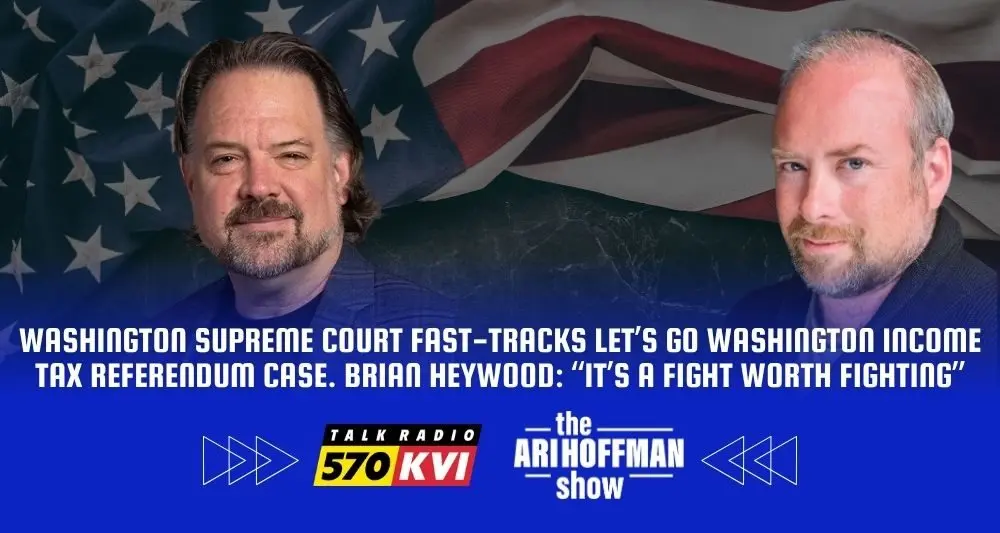
“It’s a fight worth fighting.” – Brian Heywood
The fight against Washington’s new income tax just got a major jolt of momentum. Brian Heywood, founder of Let’s Go Washington (LGW), announced that the Washington State Supreme Court has agreed to hear LGW’s emergency petition over the state’s refusal to process a referendum on ESSB 6346 — the so-called “millionaires’ tax.”
According to the court order: “At the direction of the Court Commissioner, the emergency motion for accelerated review is granted as follows: Any answer to the petition for writ of mandamus should be served and filed by April 10, 2026. Any reply to any answer should be served and filed by April 14, 2026. The petition for writ of mandamus is referred to the Court for consideration at its April 30, 2026, en banc conference.”
Breaking : The Supreme Court has agreed to hear the referendum case:
From the Court:
“At the direction of the Court Commissioner, the emergency motion for accelerated review is granted as follows:
Any answer to the petition for writ of mandamus should be served and filed by…— Brian Heywood – That Damn Mormon (@bkheywood) April 5, 2026
In plain English, the timeline is now compressed into a matter of weeks. The Attorney General must respond by April 10, and Let’s Go Washington will have just a few days after that, until April 14, to reply. From there, the full Supreme Court, sitting en banc, will consider the case at the end of the month, with a decision expected shortly thereafter. By the end of April, Washingtonians will likely know whether this referendum effort lives or dies.
If the court sides with LGW, the Secretary of State will be required to process the referendum, and signature gathering could begin immediately. That would set off a race against the clock to meet the June 10 deadline. If the court rules against LGW, however, the referendum effort is effectively blocked, forcing opponents of the tax to pursue alternative paths like a citizen initiative or a broader constitutional challenge.
Heywood: “The referendum is a straight up-or-down vote”
On The Ari Hoffman Show, Heywood explained why LGW chose to pursue a referendum instead of immediately launching an initiative campaign.
“The referendum, first of all, is a straight-up or down vote that the Constitution gives to the voters when the legislature passes a law. It’s just straight yes, you vote yes if you want to support the law they made. You vote no if you want to oppose it. It’s easy to understand, and it goes on the ballot in November after the bill is passed.”
He noted that while the referendum path is more straightforward for voters, it comes with significant logistical challenges. The campaign would need to gather roughly 200,000 signatures in a very short window, all before June 10. That timeline is tight—but, as Heywood emphasized, still achievable with enough support.
More importantly, the referendum avoids one of the political tactics often used in initiative campaigns.
“It wouldn’t be subject to a financial impact statement where they get to write, ‘oh, this goes for feeding babies and helping the elderly.’ That’s the tactic that they use to make every law unimpeachable.”
In other words, a referendum gives voters a clean, unfiltered choice—something supporters say is exactly why lawmakers are trying so hard to stop it.
The Constitutional Fight: Can the Legislature Block Voters?
At the center of this legal battle is the Legislature’s use of a “necessity clause” in ESSB 6346. By declaring the tax necessary for the support of the state government, lawmakers effectively attempted to shield the bill from a referendum.
That’s what the Secretary of State relied on when rejecting Heywood’s filing.
But Heywood argues that interpretation stretches the Constitution beyond recognition.
“I think the Constitution is fairly clear that it needs to have an immediate need, which this one doesn’t. They’ve tried to play with the wording and say, well, it’s either immediate, these other things, or anything the state wants to do. And I think it’s a fight worth fighting and taking to the Supreme Court and giving the Supreme Court a chance to look at it.”
That question—whether lawmakers can simply declare a bill “necessary” to block a vote—is now squarely in front of the state’s highest court.
“If you’re terrified of losing, you shouldn’t do anything in life”
Critics have pointed out that the Washington Supreme Court has historically sided with the government in disputes like this. But Heywood dismissed the idea that the fight isn’t worth taking.
“People are terrified of losing. And if you’re terrified of losing, you shouldn’t play baseball. You shouldn’t bowl. You shouldn’t do anything in life, right? I think you go out there and you fight the fight, and no one has really, really attempted to push back on this.”
For Heywood and his supporters, this case is about more than just one tax—it’s about finally challenging a pattern that has gone largely unchecked.
“Flagrantly telling the voters to go to hell”
Heywood also pointed to what he sees as a broader abuse of legislative power. After reviewing the most recent legislative session, he found that emergency-style clauses appeared far more frequently than one would expect for true emergencies.
“Out of the 268 laws that were enacted, 23 of them had some sort of emergency clause. That’s 10 percent… When you’re at 10 percent, you’re flagrantly telling the voters really to go to hell.”
That statistic underscores the stakes of this case. If the court allows this use of the “necessity clause” to stand, critics argue it could effectively eliminate the referendum as a meaningful check on legislative power.
Economic Concerns and a “Tipping Point”
Even though the tax won’t take effect until 2028, Heywood says the economic consequences are already beginning to surface.
“The wealthy already are leaving. You’re going to see this big glut of five-million-dollar homes just sitting there now… The people I think are going to be impacted the most are the farmers… the restaurant owners… the small business owners… They’re the ones that are going to be hit.”
He warned that delaying action could make the situation worse, not better.
“I think this year is one of those tipping points… waiting into next year is a very dangerous thing… I think it’s not too late. I think it can be done this year. But we really need everybody to step up.”
The Clock Is Ticking
If the court allows the referendum to move forward, the next phase will be a sprint. Supporters will need to gather well over 150,000 valid signatures—closer to 195,000 to be safe—and submit them by the June 10 deadline.
That means immediate mobilization across the state, with volunteers, donors, and organizers all playing a role.
As Ari Hoffman put it during the interview, the urgency couldn’t be clearer: the fight isn’t next year—it’s right now.