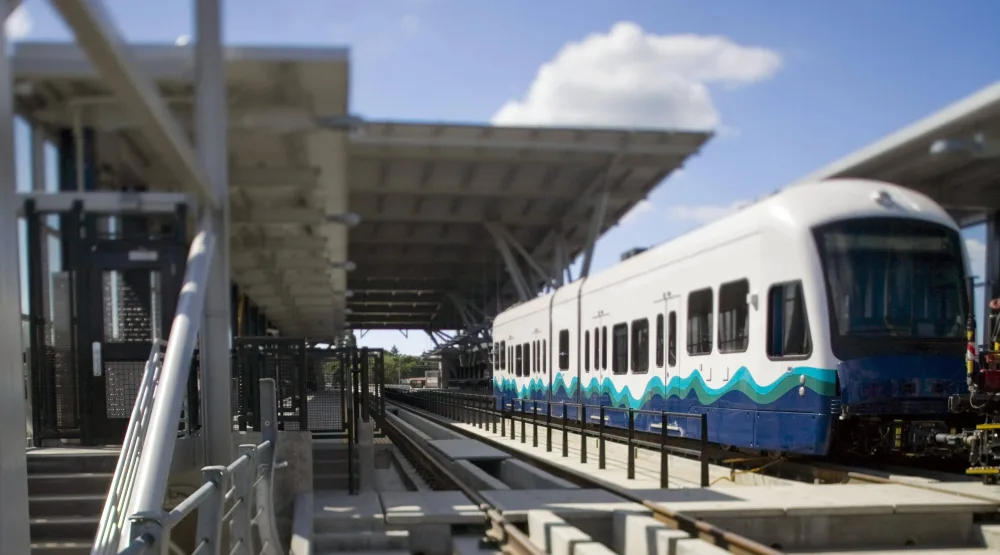
After a long-awaited and much-celebrated opening this past weekend, the brand-new Mercer Island light rail station is already dealing with a reality many critics warned about.
Within hours of launch, emergency crews responded to a drug overdose at the station. According to dispatch audio, a man was revived with Narcan and later declined further medical treatment.
And so it begins. After it's much celebrated opening this past weekend, the brand spankin' new Mercer Island light rail station has already had it's first OD. If you're wondering, the junkie survived after being revived with Narcan.
And the funny thing is, urbanists and transit… pic.twitter.com/uv81mKoqd3
— Peak Seattle (@PeakSeattle) March 30, 2026
At nearly the same time, transit officers were dispatched to deal with a separate incident: a man reportedly smoking and sleeping on the floor of a train near Mercer Island. Officers made contact, got him off the floor, and resolved the situation without offering further details.
Bonus round. Here's a separate report of a (presumably homeless) man smoking and sleeping on the floor of a train at Mercer Island. pic.twitter.com/9WKwFQEvsi
— Peak Seattle (@PeakSeattle) March 30, 2026
So much for the grand opening glow.
For years, anyone raising concerns about crime, drugs, or disorder following light rail expansion into the Eastside was dismissed. Critics were mocked as “NIMBYs” and “pearl clutchers.” Urbanists and transit advocates insisted those fears were overblown—or outright imaginary.
And yet, here we are.
The day after the grand opening, the system has already logged:
- A drug overdose requiring Narcan
- A disorderly conduct call involving smoking and sleeping on a train
That’s not speculation. That’s not hypothetical. That’s reality.
There’s also growing frustration about how rules are enforced on the system.
Word from riders is that transit police are quick to check tickets for regular commuters—but appear far less interested in confronting vagrants. Whether that’s due to policy, lack of staffing, reluctance, or so-called “equity” considerations remains unclear.
But the perception matters. And right now, that perception is that enforcement is selective at best.
This isn’t happening in a vacuum.
One Eastside resident reported seeing something near the Bellevue Square station he’d never witnessed before: multiple vagrants on street corners holding signs—four different spots, in a single outing.
For longtime residents, that’s a noticeable shift.
And it raises a bigger question: is this the beginning of a broader change spreading eastward?
All of this comes as Sound Transit celebrates the completion of the 2 Line extension—part of the “Crosslake Connection” linking Seattle and the Eastside by light rail for the first time.
The 7.4-mile extension includes stations at Judkins Park and Mercer Island, and runs across the I-90 floating bridge—a first-of-its-kind engineering feat.
The project has been in the works since voters approved Sound Transit 2 back in 2008. Originally slated to open in 2020, it faced years of delays due to planning disputes, construction challenges, and even the need to rip out and replace faulty concrete plinths on the bridge.
Now complete, the 2 Line connects with the 1 Line at International District/Chinatown Station, creating a unified regional system. Trains are scheduled to run from 5 a.m. to midnight, with service every 8 minutes during peak hours.
Opening day drew crowds, speeches, ribbon cuttings, and praise from elected officials, including Sen. Patty Murray, Gov. Bob Ferguson, and Sen. Maria Cantwell.
But officials ignored the chronic homeless encampment, which has plagued the neighborhood for years, right next to the brand-new station.
Unbelievable turnout today for the grand opening of the Light Rail from Judkins Station to the East Side. I saw Senator Patty Murray, Senator Jamie Pedersen, Mayor Mark Mullet, Past CP Sara Nelson, CEO Dow Constantine, Senator Maria Cantwell, Mayor Katie Wilson, and Governor Bob… https://t.co/c35QFFF4Zb pic.twitter.com/1Eh7vpksIy
— We Heart Seattle (@weheartseattle) March 29, 2026
For supporters, this is a historic milestone, a transformative transit investment connecting communities across Lake Washington.
For skeptics, the early incidents confirm what they feared all along.
Either way, the honeymoon period didn’t last long.
The question now isn’t whether problems will emerge—it’s how quickly they’ll grow, and whether anyone is willing to address them before they become permanent features of the system.
Get ready, Eastside. Seattle just got a lot closer.