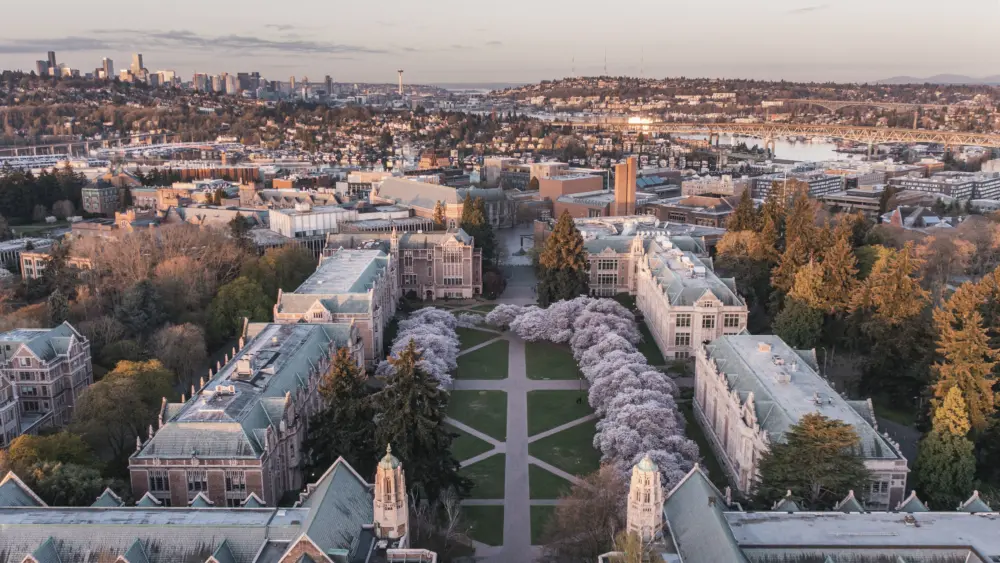
University of Washington President Robert J. Jones said the school is rewriting its student conduct code after last year’s destructive campus riots exposed what he called a serious inability to hold students fully accountable, as he faced pointed questions from the Jewish community about antisemitism, faculty activism, and campus safety.
Speaking Sunday at a town hall titled “Combating Antisemitism on Campus” at an Orthodox synagogue in Seattle’s Seward Park neighborhood, moderated by conservative radio host Ari Hoffman, Jones pointed to the anti-Israel and Antifa activists who vandalized UW’s engineering building — causing more than $1 million in damage — as a turning point.
“Our student conduct code was not written for this moment in time,” Jones said. “It does not allow us to hold people accountable for the kind of conduct we’re now seeing on campuses.”
The review, now underway with outside experts, is expected to lead to significant changes in how the university disciplines students involved in disruptive or destructive protests. Thirty-three of the activists now face formal charges of first-degree criminal trespass.
“To go into a brand new facility and to do the damage that was done is just something that I still have trouble getting my arms around,” Jones said. “What was the intentionality? What was supposed to be achieved by that?”
Jones added that while protest is a staple of campus life, schools must still enforce rules and protect students. “I expect people to protest, but I expect people to abide by university policies,” he said.
‘Nothing more we could do’
Hoffman pressed Jones on a question that has fueled anger among many in the Jewish community: why students involved in the building takeover and earlier campus damage were allowed to return.
"There are now 23 students back on campus who were involved in over $1 million worth of damage…How can the Jewish students feel safe?
Watch the full interview with University of Washington President Robert J Jones here: https://t.co/cfrvneXWt8 pic.twitter.com/9K35FwLQgR
— Ari Hoffman (@thehoffather) March 23, 2026
Jones said the university imposed the maximum penalties available under current rules — including multi-quarter suspensions, lost tuition, and the suspension of a student organization — and referred the cases to prosecutors.
But he acknowledged those consequences fell short of what many had hoped for.
“There was nothing more that we could do based on the limitations of the student conduct code itself,” Jones said.
The incident, he said, underscored the need for change.
“I will always advocate for free speech,” he added. “But when you cross into destroying public property and putting people in harm’s way, that is not acceptable.”
Antisemitism ‘growing exponentially’
The discussion, held before students, parents, and community members, focused heavily on rising antisemitism at UW and across the country.
Jones defined antisemitism as “a directed form of hatred and bigotry” targeting Jews because of their shared ancestry and beliefs, and said it has grown “almost exponentially” in recent years.
“I’ve seen it happen at every university that I’ve been a part of,” he said.
He argued that university leaders must confront it not only through enforcement, but by showing up and engaging directly with affected communities.
“It all starts with a conversation,” Jones said.
Free speech flashpoints
Hoffman asked whether phrases commonly heard at campus protests — including “globalize the intifada” and “from the river to the sea” — should be considered antisemitic.
Do the phrases, 'Globalize the intifada,' 'from the river to the sea, Palestine will be free,' or 'Zionists or N*zis' count as anti-Semitism, because those were chanted on campus & it wasn't addressed
Full interview with UW President Robert Jones here: https://t.co/cfrvneXoDA pic.twitter.com/jPer7GEEmQ
— Ari Hoffman (@thehoffather) March 23, 2026
Jones acknowledged those phrases are widely viewed as threatening by Jewish students, but said the university must be cautious in regulating speech protected by the First Amendment.
“For many, that falls into the category of free speech,” he said. “But I know the historical context … and for a lot of people, it is viewed to be very antisemitic and very threatening.”
Jones said his focus is on conduct rather than trying to adjudicate every slogan.
“I’m more concerned about behavior that is clearly threatening,” he said.
New training, reporting, and enforcement
Beyond revising the conduct code, Jones said UW is expanding its response infrastructure, including mandatory civil rights training for students, faculty, and staff, as well as a strengthened Title VI office to handle complaints.
He said past systems were often unclear and inconsistent, leaving students unsure how to report incidents or what would happen after they did.
“For perhaps the first time, we have more structures, more procedures, and more education on the front end,” Jones said.
He emphasized that universities must do more to prevent incidents, not just react to them.
“We have to work upstream,” he said.
Faculty under scrutiny
Hoffman also raised concerns about faculty members accused of promoting antisemitic views or using university platforms for political advocacy.
Jones defended academic freedom as a core principle of higher education, but said it must be balanced with responsibility.
“With academic freedom comes great academic responsibility,” he said.
He acknowledged ongoing concerns about faculty using university branding or classroom settings in ways that appear to represent institutional positions, and said UW is working to clarify expectations and improve oversight.
Rebuilding trust
The town hall marked a rare direct exchange between UW leadership and a community that has been sharply critical of the university in recent years.
Hoffman, who described himself as a frequent critic of UW, said the event was an important step.
“I don’t think we’re going to solve everything today,” he said, “but this is a start.”
Jones agreed, framing the conversation as the beginning of a longer effort.
“We’re absolutely committed to work collectively with you,” he said.
He said his goal is for UW to become a national model for how universities confront antisemitism while balancing free speech and campus safety.
“At this moment in time,” Jones said, “we have to be intentional about creating a community where all students feel safe and supported.”
The town hall, sponsored by Bikur Cholim Machzikay Hadath — the oldest synagogue in Washington state — along with Sephardic Orthodox synagogue Congregation Ezra Bessaroth, Temple De Hirsch Sinai, Northwest Yeshiva High School, the Seattle chapter of the American Jewish Committee, and StandWithUs Northwest, drew demands from Antifa-aligned activists and Jewish Voice for Peace to shut it down because they objected to Jones speaking with Hoffman at what they called a “Zionist” venue.
ANTIFA & BDS FAIL
Today, my synagogue hosted UW President Robert Jones for a town hall about antisemitism on campus. Since they heard about it, Hamasniks & Antifa activists have been trying to shut it down.
They organized a letter-writing effort to try to get the president to… pic.twitter.com/JOAiN6KGD8
— Ari Hoffman (@thehoffather) March 22, 2026
JVP Seattle demanded that Jones “withdraw from his town hall on antisemitism,” alleging the group had been trying to meet with him “for nine months.” Activists urged supporters to show up at the synagogue to protest, but none did.
Jones said he was willing to “meet with anyone that wants to spend time and is interested in hearing my perspective.”