
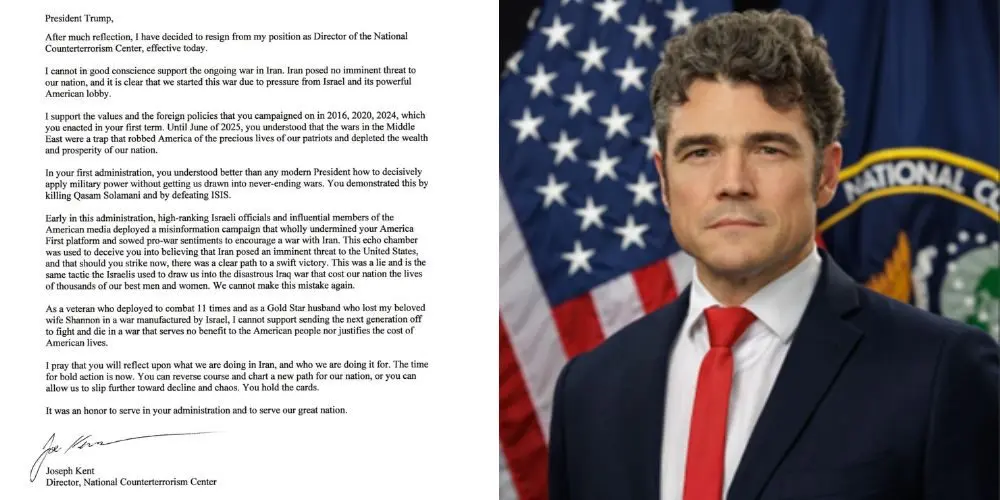
Joe Kent is someone I’ve had on my show many times, and that’s part of why this is so frustrating. The most authentic I ever heard him was not talking politics, but talking about his wife, Shannon Kent, a U.S. service member who was killed in 2019 in a suicide bombing in Syria. ISIS claimed responsibility. ISIS—not Israel, not a “lobby,” but ISIS, a terrorist organization hostile to the United States, Iran, and Israel alike. I remember interviewing Kent for a 9/11 anniversary special, and he spoke candidly about his wife, his sons, and how September 11 shaped both of their lives. That was real. That was human. Which is exactly why his resignation this week felt so jarring: the man who once spoke so plainly about sacrifice and terrorism is now making claims so sweeping, so contradictory, and so disconnected from both history and his own record that they collapse under even basic scrutiny.
Joe Kent’s Arguments Collapse From His Own Statements
“You don’t get to say Iran is trying to kill a US president & also say Iran is not a threat. Joe Kent’s biggest problem is Joe Kent contradicting Joe Kent.” pic.twitter.com/F6kUsFCY3X
— Ari Hoffman (@thehoffather) March 18, 2026
Kent’s resignation letter argued that Iran posed “no imminent threat,” that the United States entered the war because of “pressure from Israel and its powerful American lobby,” and that this was essentially Iraq all over again. Start with the first claim. Iran has a documented, decades-long record of hostility toward the United States: the 1979 hostage crisis, the 1983 Beirut barracks bombing that killed 241 U.S. Marines, the 1996 Khobar Towers attack, the Pentagon’s attribution of at least 603 American deaths in Iraq to Iran-backed militias, and the 2020 missile strike on U.S. bases in Iraq that left more than 100 U.S. personnel with traumatic brain injuries. That’s not theory—it’s history. And Kent himself has acknowledged it. In his own tweet, he wrote: “Iran has been after Trump since January of 2020, after he ordered the targeted killing of the terrorist Qasem Soleimani. This isn’t a new threat.” That statement alone undercuts the core of his resignation. If Iran has been targeting a U.S. president, then by Kent’s own words, Iran is a threat. He cannot simultaneously claim both things.
The White House pushed back forcefully. Press secretary Karoline Leavitt said there were “many false claims” in Kent’s letter and argued that President Trump had “strong and compelling evidence” Iran was preparing to strike first, adding that the idea that foreign actors manipulated the president was “insulting and laughable.” Whether you agree with that assessment or not, it establishes something important: Kent is not presenting an uncontested fact pattern—he is presenting one side of a disputed intelligence judgment and treating it as settled truth.
His claim that Israel dragged the United States into war is even more problematic. Kent points to Iraq as precedent, but the Iraq War is one of the most studied foreign policy failures in modern history, and its causes are well understood. The central issue was flawed U.S. intelligence, not foreign manipulation. The most infamous example is the source known as “Curveball,” an Iraqi defector who claimed Saddam Hussein had mobile biological weapons labs. That claim made its way into intelligence reports, public arguments, and even Colin Powell’s UN presentation. It was later proven to be completely fabricated. German intelligence doubted him, U.S. analysts raised concerns, and there was no independent verification—yet it was treated as fact. That is what Iraq was: a failure of American intelligence and decision-making. There is no evidence that Israel orchestrated that process.
In fact, Israel’s position at the time points in the opposite direction from Kent’s claim. Ariel Sharon said in 2002 that Iran was more dangerous than Iraq and warned about the consequences of a prolonged occupation. The push for Iraq came from American policymakers like Paul Wolfowitz, Robert Kagan, and Bill Kristol, who had advocated removing Saddam Hussein for years. And the outcome? It strengthened Iran. Post-Saddam Iraq became dominated by Shiite factions aligned with Tehran, contributing to the rise of the “Shiite Crescent” across the region. That is not a strategic victory for Israel—it is a complication that empowered one of its primary adversaries.
Kent’s rhetoric also overlaps with broader narratives—such as claims that Israel created ISIS—that do not withstand scrutiny. ISIS emerged from Abu Musab al-Zarqawi’s network, the chaos of post-Saddam Iraq, and the Syrian civil war. Claims tying its creation to Israel originated largely from Iranian officials and have never been supported by credible intelligence or independent investigations. ISIS has also carried out attacks against Israel itself.
What makes Kent’s position especially difficult to take seriously is how sharply it conflicts with his own prior statements. In a 2022 position paper shared with AIPAC, Kent wrote that he was “intimately familiar with the help that Israel has provided the United States” and noted that U.S. forces relied on Israeli intelligence to accomplish missions and keep Americans alive. He described Israel as a key ally and identified Iran as a shared enemy. After October 7, Kent blamed Iran for enabling Hamas, argued that Israel needed strong U.S. support, and attacked his opponent, Marie Gluesenkamp Perez, for not backing Israel strongly enough, accusing her of prioritizing domestic issues over defending Israel and protecting U.S. troops from Iranian threats. At that point, his framework was clear: Iran was the aggressor, and Israel was the ally. Now, suddenly, that framework is inverted. Iran is no threat, and Israel is the problem. That is not a minor shift—it is a complete reversal.
There are also questions about Kent’s credibility at the time of his resignation. Reporting has suggested he had been cut out of intelligence briefings and was not involved in Iran planning discussions, while concerns had been raised about leaks. If true, that matters because Kent presents his claims as if they come from inside the decision-making process. But if he was no longer part of that process and about to be fired, that significantly weakens the authority of those claims.
Additional context comes from reports linking Kent’s current wife to the orbit of Max Blumenthal, a figure who has worked with outlets like RT, Russian state media, and Al Akhbar, which has been associated with Hezbollah-aligned messaging. This is not proof of influence, nor is it an argument on its own. But it is relevant when the narrative Kent is now advancing—that Israel manipulates U.S. foreign policy—closely mirrors themes long promoted in anti-Western and adversarial media ecosystems.
And then there’s what Kent chose to do next. If you are making claims this serious—accusing your own government of being misled into war by a foreign ally—you would expect him to go to the mainstream media to defend those claims. They would likely embrace him because his message can align with their anti-war rhetoric. Instead, Kent is going on Tucker Carlson’s show and is scheduled to share a stage with Candace Owens. Both are platforms that have increasingly trafficked in the same bogus narratives Kent is now echoing. If the goal is to present evidence and withstand scrutiny, there are plenty of outlets—across the political spectrum—where that could happen. Choosing instead to go to rabidly antisemitic, and increasingly anti-American platforms raises the obvious question: is this about proving a case, or promoting a narrative?
Of course Joe Kent books an interview with Tucker first. It's who he has allegedly been leaking information to
Leaking information to an anti America podcaster isnt America First pic.twitter.com/Ku3FnIsjEh
— Ari Hoffman (@thehoffather) March 18, 2026
Kent’s argument follows a familiar pattern: minimize the actions of a hostile actor like Iran, shift responsibility away from U.S. decision-making, and attribute agency to an external force. It’s hard to make the argument that anyone influences President Trump, let alone an external force.
I don’t take any pleasure in writing this. Joe Kent is someone I’ve interviewed many times, and I’ve seen him at his most genuine, talking about his wife, his family, and his service. That’s what makes this more frustrating. Because if he wants to argue that the war is a mistake, that the intelligence is flawed, or that the strategy is wrong, that is a legitimate debate. But claiming that Iran posed no threat, after acknowledging in his own tweet that Iran has been targeting a U.S. president since 2020, and over 1,000 Americans have been killed by a regime trying to develop nuclear weapons while chanting “death to America,” is not a serious argument. Claiming that Israel manipulated the United States into war, after praising Israeli intelligence and campaigning as a staunch supporter of Israel against Iran, is a contradiction. And invoking Iraq while ignoring the well-documented failure of American intelligence is a rewrite of history.
If you are going to make accusations this large, against an ally, against your own government, against the intelligence process, you need evidence. Not rhetoric. Not implication. Not contradictions. Evidence. And right now, Joe Kent hasn’t provided it. Instead, he has resorted to some of the oldest debunked conspiracy theories from the dark corners of history and the internet, then ran to those who traffic in falsehoods to validate them.