Before we went on air Tuesday, we got the ruling from a federal court here in Washington denying the temporary restraining order in our fight to get press passes to cover the Washington State Legislature.
As this fight has unfolded, Republicans have been battling Democrats’ income tax push on the House floor in a marathon session. This is exactly the kind of moment when reporters should be in the room, asking questions, watching the floor, and telling the public what is happening in real time.
On Monday, reporters were sitting in the gallery of the federal court. I assumed they were there to cover our press freedom case.
Turns out they were there rooting for the government to win.
My reaction to the judge's decision against our freedom of the press pic.twitter.com/heBSW6NSow
— Ari Hoffman (@thehoffather) March 11, 2026
It would be really nice if a few reporters like Brandi Kruse, Jonathan Choe, and me were down there to cover it.
But we are not given the same access to House press areas that members of the Seattle Times, the Washington State Standard, and others are given. We get press access at the governor’s office. We get it in the Senate. But we do not get it in the House.
So we sued.
When the House denied our applications, we asked the court for a temporary restraining order, basically emergency relief, so that we could get press passes through the end of the legislative session. The judge denied that request. The lawsuit, however, is very much alive. Today’s ruling was only about emergency relief.
And that brings us to the heart of the case: the First Amendment, freedom of the press, freedom of speech, and how journalism actually works in 2026.
Let’s start with the obvious. I do not think anyone seriously disputes that the state can have some guidelines for press credentials. Governments can impose some decorum. They can set basic standards. The issue is not whether guidelines can exist.
The issue is what those guidelines are.
Right now, the Washington State House, with Speaker Laurie Jinkins and the Capitol Correspondents’ Association guiding this process, is using standards that say if you are involved in advocacy of any kind, you may not count as a “professional journalist.” That is not just an outdated view of how the media works. It is a misunderstanding of how the media has always worked.
Some of the earliest and bravest journalists in American history were pamphleteers. Thomas Paine risked everything by writing “Common Sense.” He wrote with conviction. He wrote with purpose. He wrote opinions. And for much of what those writers published against the Crown, they could have paid with their lives.
So the idea that having opinions, or advocating for or against something, somehow disqualifies you from journalism is beyond ridiculous.
The House’s position, as applied to us, is that because Brandi Kruse and I have spoken at Let’s Go Washington events, we should not be allowed to have press passes. That is insane. Not because rules should not exist, but because journalism has never required the absence of opinion. If it did, much of American journalism would never have existed.
This is not just about conservative media, right-leaning media, or “common sense” media having access. I believe everybody should have access.
The judge wrote in the ruling that the plaintiffs — myself, Brandi Kruse, and Jonathan Choe — “offer no evidentiary support for their belief that their exclusion was ideologically motivated, rather than rooted in their failure to meet the neutral standards laid out in the CCA guidelines.”
But here is the problem with that reasoning: they literally said they were excluding us because of advocacy. If the state is deciding that expressing support for certain positions disqualifies you from press access, that is not some neutral abstraction. That is ideology by another name.
And where, exactly, are these supposedly neutral CCA guidelines? Can you find them? Is there a website? A public posting? A place where ordinary citizens — or ordinary journalists — can read the standards that determine who gets access to the people’s House?
No. They are not publicly available in any meaningful way. That is part of the problem.
The ruling also leans on the idea that the credential system includes reporters from a variety of outlets. The judge wrote that “the inclusion of a broad range of media outlets on both sides of the political spectrum certainly diminishes any claim that the list is based on political ideology.”
And part of that discussion points to outlets like the Seattle Times.
Let me be clear: I am not saying the Seattle Times should not get press passes. Of course it should. But the Seattle Times advocates for issues too. On the very day we were denied our press passes, the paper’s ownership was down in Olympia advocating for a tax on Big Tech to support their struggling outlet. So spare me the fiction that only some advocacy counts and some does not.
That double standard became even harder to ignore in court.
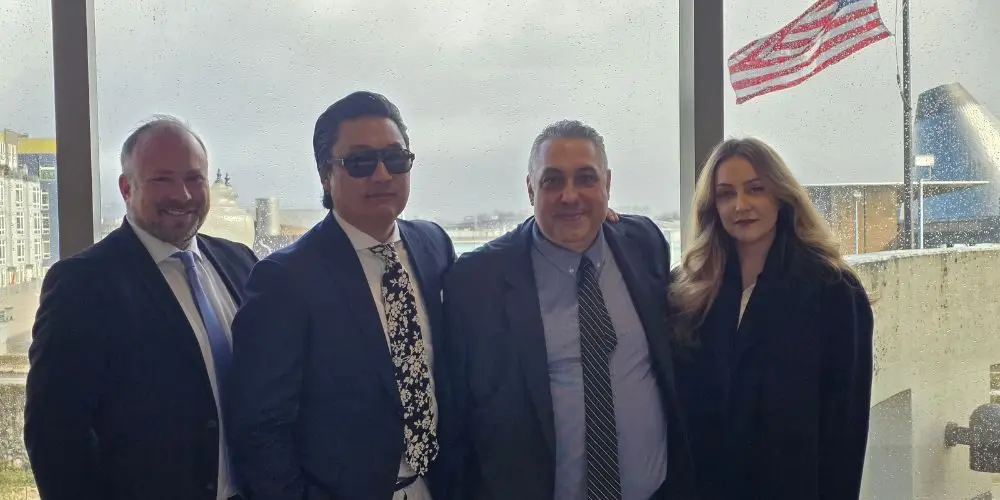
Monday, in Tacoma, in that old train-station courthouse with all the brass and grandeur, our side sat at the plaintiffs’ table: our lawyer Jackson Maynard, Brandi, Jonathan, and me — yes, even in a tie. Across from us sat the lawyers for the House, the Attorney General, and the Capitol Correspondents’ Association. And in the gallery were reporters.
At first, I was glad to see them. I thought, great, they are here to cover this fight over press freedom. But later, when I looked for the stories, I could not find them. And that is when it clicked: they were not there to cover the case. They were there, in effect, to root for one side of it.
Jerry Cornfield of the Washington State Standard is not just a reporter. He is tied to the very credentialing structure that decides who gets press access. His outlet benefits from this closed ecosystem. That is not healthy. That is not accountability. If the media is supposed to hold government accountable, why would members of the media support a system that hands control right back to government insiders and incumbent players?
And that is one of the reasons this case matters so much. Anytime you advocate against a government policy, anytime you challenge government power, someone can say you are no longer neutral enough to be the press. But journalism, at its core, is often adversarial. If criticizing the government turns you into an activist in the eyes of the government, then independent journalism is in trouble.
The judge wrote when denying the TRO: “It is unclear what effect, if any, this sort of ruling would have on the current circumstances, in which Plaintiffs were denied press passes on specific dates over a month ago,” claiming that undoing the denial of a day pass from six weeks ago does not automatically hand us a pass today.
But the court also suggested we should have kept applying over and over. The ruling notes that “Plaintiffs had not applied for press passes other than those previously denied” and says we were effectively trying to “sidestep the press pass application process entirely and use the judicial process as their application instead.”
That logic makes no sense.
Why would I apply every single day for a pass that I already know will be denied every single day under the exact same criteria? What is the point of collecting rejection emails like baseball cards? The House had already made its position clear. The criteria were not changing. Reapplying again and again would not solve the constitutional problem.
The judge also observed that “Plaintiffs do not appear to challenge press credentialing itself under the First Amendment.” In other words, the court saw us as challenging how the rules were applied, not necessarily the rules themselves.
And I think that may shape the next phase of the case.
Because if this continues — and it will — then maybe the clearer path is to challenge the rules themselves. Not the idea that some standards can exist, but the substance of these standards: standards so outdated that they treat opinionated journalists as if they are not journalists at all.
Then there is the court’s statement on harm. The judge wrote: “The Court is skeptical that Plaintiffs have suffered an irreparable injury that warrants granting a TRO.”
That deserves a serious response.
If I wanted to be petty, I could talk about the audience, the interviews, the traffic, the clicks. I could probably calculate what exclusive access to lawmakers during a dramatic legislative fight would mean in pure media terms. But that is not actually the point.
The point is that we do not have access.
And I do not just mean physical access to Olympia. I mean practical press access. When I email Democratic officials, many do not respond. Bob Ferguson’s office has never once gotten back to me. Bruce Harrell never once got back to me for comment. Katie Wilson? Never. Many Democratic lawmakers refuse interviews altogether. What they will do is send out carefully worded press statements that answer nothing.
That is why access in the room matters.
When you are there, as we have seen from Brandi’s clips and Jonathan’s clips, you can ask the question that forces an answer. You can catch the exchange. You can see what is happening on the wall, in the hallway, on the floor, in the corners where the real story lives.
The legislative session happens once. The votes happen once. The debates happen once. If reporters are blocked from covering lawmakers in real time, from observing what is happening on the floor and asking questions in the moment, that is not something you can fix six months later.
You can watch on TV. You can sit in the gallery. But you cannot do the actual work of a floor reporter from those places.
Last night, for example, State GOP Chair Jim Walsh spotted a chart on the Democratic side laying out when Democratic members needed to be on the floor during the Republican floor fight. A nap schedule. Think about that. If someone had not spotted and posted that, the public might never have known.
That is exactly the kind of detail real reporters in the room are supposed to catch.
That is what the House is keeping from us.
And the public should ask why.
Why is it that the Seattle Times and the Washington State Standard get this access while independent outlets and journalists who ask uncomfortable questions are frozen out?
Why are the people who challenge the government most aggressively the ones the government most wants to exclude?
This fight is not over.
The restraining order was denied. The case continues.
And we will keep covering the story — because that is what journalists do.