
I called it. I saw this coming a mile away.
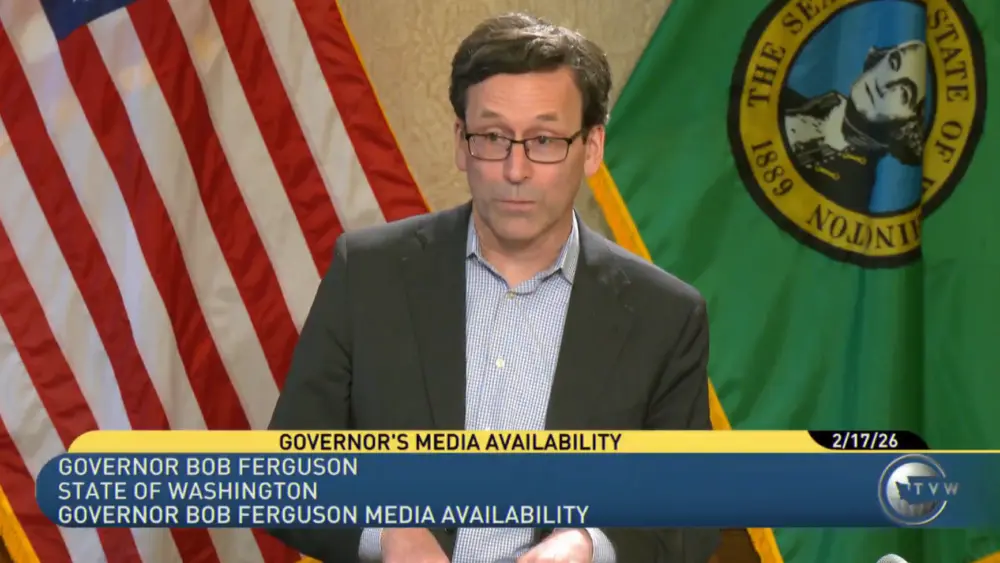
By now, Bob Ferguson’s move was entirely predictable. For days, we were treated to the usual theater: reports that he was “not sure” he could sign this new tax package, hand-wringing from Democrats about internal division, whispers that maybe this time they’d draw a line. And then, right on cue, Ferguson announced he would sign it. Every Democrat fell in line.
“This isn’t just a ‘millionaires tax’ bill. It’s a rewrite of the entire tax code to pave the way for an income tax.”
My deep dive into the Democrats' plan to tax every Washingtonian pic.twitter.com/w38G3CikAa
— Ari Hoffman (@thehoffather) March 8, 2026
Of course they did.
If you’ve watched Olympia for any length of time, you know the routine. Public hesitation. Private pressure. Eventual obedience. Earlier this year, when I was broadcasting from the Washington State Legislature, some Republicans urged me to watch committee hearings carefully. Their advice was simple: watch what happens “anytime a Democrat wants to vote against the other Democrats.” They said leadership would call a recess or executive session, pull that member out of the room, and when everyone came back, the wavering lawmaker would return looking all sad or sullen — and then vote the way leadership wanted.
That tracks with what I’ve seen myself.
So no, I’m not surprised by what happened here. The surprise is that anyone still pretends this is merely a tax on the rich.
Because it isn’t. ESSB 6346 is not just a “millionaires’ tax” bill. Anybody calling it only that is either uninformed or deliberately misleading people about what this legislation actually does.
Yes, the headline provision is a new tax on high-income households. That much is true. But the bill is structured as something much bigger: a broad rewrite of Washington’s tax code designed to pave the way for an income-tax regime and expand the state’s taxing apparatus far beyond one narrow class of people.
This is not just a top-line rate increase aimed at a handful of wealthy residents. It creates a new Washington taxable-income base tied to federal adjusted gross income, then layers in state-specific additions, subtractions, deductions, exemptions, credits, sourcing rules, apportionment formulas, pass-through entity taxes, administrative rules, and new treatment for things like pension income and multistate work. That is not a symbolic levy. That is a blueprint.
This bill retools the machinery so Washington can tax income in a far more expansive and permanent way.
Supporters want you focused on the slogan. They want you to hear that it only affects people making more than $1 million and stop reading there. But the text tells a different story. This is a comprehensive tax overhaul. It builds detailed rules for residents and nonresidents, wages and business activity, pass-through entities, professional athletes, student-athlete NIL income, and people doing business in Washington from somewhere else. If you’re here to work, if you earn money tied to work performed here, if you have business activity here, the state is laying the groundwork to reach farther and farther into that stream.
That is why this should not be described as merely a tax on “millionaires.” It is a systemic rewrite.
And we’ve seen this pattern before. Democrats promise a narrow tax aimed at a politically convenient target, insist ordinary people have nothing to fear, and then use the new revenue mechanism, the new definitions, and the new administrative structure as the basis for expanding government’s reach later. They have spent years arguing that Washington’s system is “regressive, regressive, regressive.” Their answer is always the same: tax a small group now, normalize the framework, and expand the logic later.
Eventually, they run out of other people’s money. Then they come for yours.
That is the part of this debate too many people are ignoring. Democrats are not building a one-off policy. They are building an architecture.
And the architecture matters because the bill is not even honest on its own terms. We were told this was about fiscal urgency, about budget gaps, about the need to address a crisis. Fine. Then why is so much of this structured as a long-term redesign of the code? Why is it tied to a broader set of tax credits, carveouts, exemptions, implementation mechanisms, and downstream transfers?
As written, the package does not simply impose a new high-income tax. It also expands low-income tax relief, adds sales and use tax exemptions, creates an elective pass-through entity tax, changes how certain pension income is treated, and coordinates those provisions as part of an integrated framework. Even supporters acknowledge the new taxes are meant to operate together with other reductions and credits — and that some of those relief provisions would be unwound if the core tax were repealed or struck down.
It is pitched as fairness. It is sold as compassion. It is wrapped in the language of helping kids, low-income families, education, health care, and social services. But read the bill closely and what you see is not simplicity or relief. You see bureaucracy. You see categories. You see permanent infrastructure. You see a state government that wants more control, more extraction, and more ways to reach into economic life.
And what happens next is not hard to predict.
Businesses will leave. Some already are. Wealthy residents will relocate. Employers will shrink their footprint or quietly move jobs elsewhere. Some will stop expanding here at all. Others will keep the nameplate in Washington while shifting growth, hiring, and investment outside the state. Politicians in Olympia may pretend there is no consequence to that, but anyone who lives in the real economy knows better.
People make choices. Capital makes choices. Employers make choices. Families make choices.
If Washington becomes a place where the tax code is unstable, punitive, ideological, and designed for constant expansion, people will flee.
And when they do, the people left behind will be told the answer is still more taxation.
That is why the “millionaires’ tax” label is so deceptive. It encourages voters to think this is somebody else’s problem. It is not. It is a structural change with implications for business formation, investment, residency decisions, multistate work, and the future of taxation in Washington. Once the framework is in place, the political debate is no longer whether Washington should tax income. That question has effectively been answered. The only future debate is who else gets pulled in.
ESSB 6346 is not merely a tax on high earners. It is a comprehensive effort to rewrite Washington’s tax code, normalize an income-tax structure, and prepare the state to reach deeper into the lives of workers, investors, retirees, and businesses alike.
Call it what it is.