King County prosecutors have finally filed charges against the 33 activists arrested after occupying and vandalizing the University of Washington’s brand-new Interdisciplinary Engineering Building last spring, an incident that reportedly caused more than $1 million in damage. The building had been operational for barely a month.
But the charges weren’t felonies. Criminal trespass in the first degree—a gross misdemeanor—for each defendant.
“A million dollars in damage. Barricaded exits. Fires outside the building. And the charge is… trespass.”
UW should know by now that when the punishment is light, the next occupation becomes inevitable. pic.twitter.com/3L4VOejaId
— Ari Hoffman (@thehoffather) March 5, 2026
That charging decision isn’t just soft. It’s consequential. It tells every future campus faction—left, right, or otherwise—that you can seize a building, barricade exits, set fires outside, and still expect the system to treat it like a glorified curfew violation.
Start with the basics: what does “gross misdemeanor” mean?
In Washington, a gross misdemeanor carries a maximum penalty of 364 days in jail and a $5,000 fine. That’s the cap. But the practical question is obvious: does anyone seriously believe King County courts will come anywhere near that maximum for this kind of politically branded protest case?
The more honest answer is: no, and everyone involved knows it.
Which is why the bigger question isn’t about the statutory maximum. It’s about the felony charges prosecutors chose not to bring—charges that, based on the police narrative alone, appear to be sitting in plain sight.
The probable cause narrative reads like a felony checklist
The public documents are revealing because they aren’t vague: they outline conduct that goes well beyond “unlawful presence in a building.”
According to the police account, demonstrators entered after business hours through a propped-open door. Vehicles then arrived and unloaded large pieces of plywood, metal barriers, and supplies—the kind of detail that screams “planned operation,” not spontaneous protest.
Soon after, a university employee tried to leave. He found the main doors barricaded by furniture. He tried another exit. That door was glued shut. He was, for a time, trapped in a building seized by masked intruders.
Unlawful imprisonment is a Class C felony in Washington. When someone is prevented from leaving a place they have a right to leave, that’s not a “disruption.” That’s not “speech.” That’s confinement.
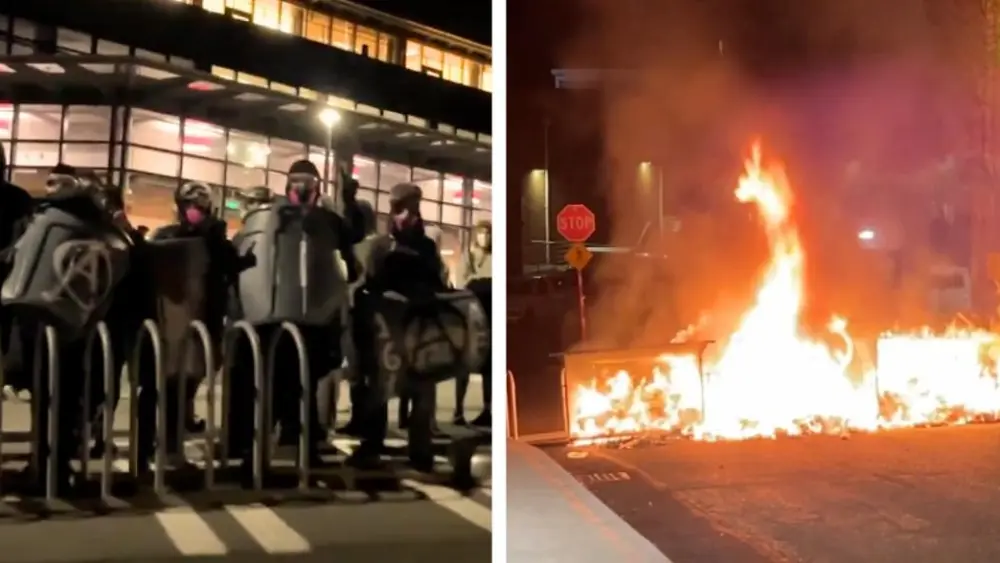
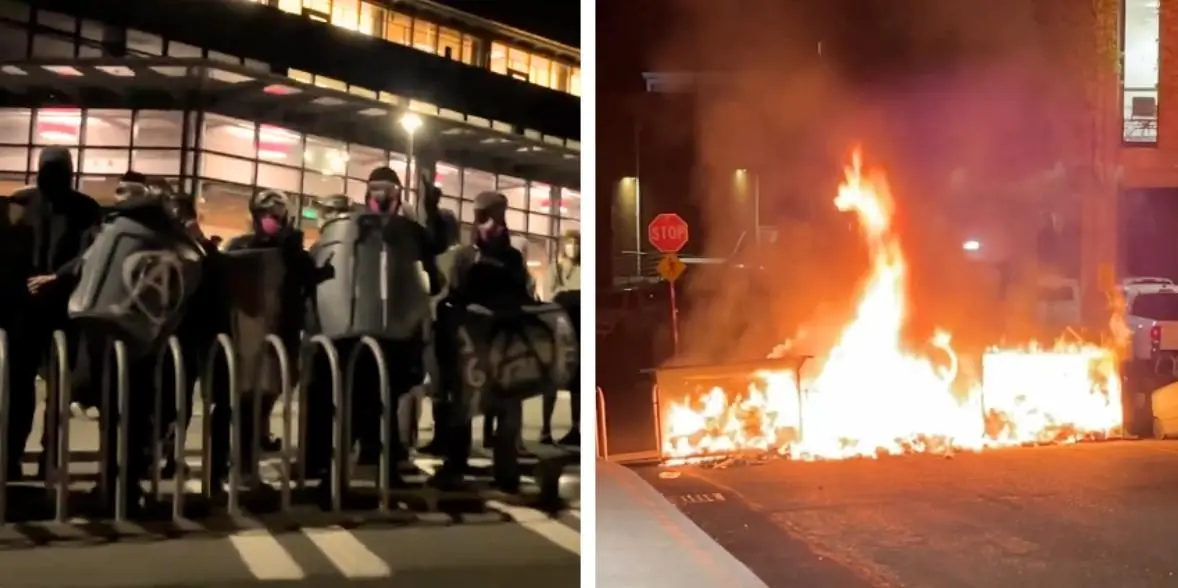
Police issued dispersal orders. The crowd refused. And before law enforcement’s deadline elapsed, two dumpsters outside were set on fire, delaying entry because the fire department had to respond.
Setting property on fire is not a misdemeanor. It’s not “political expression.” It’s potentially arson.
Arson in the second degree is a Class B felony in Washington. At a minimum, prosecutors could look at reckless burning, also a felony. And when the event involves coordinated groups, barricades, masked participants, and makeshift shields, the law doesn’t lack options. It includes riot statutes for situations involving collective force or violence.
Yet King County chose… trespass.
“We can’t prove who did what” is not the standard used elsewhere
Here is the rationale that has been floated: there’s allegedly no video inside the building, so prosecutors claim they can’t prove which individual committed which specific act of vandalism.
Most felonies are not prosecuted with perfect video evidence. Prosecutors routinely build cases using circumstantial proof—who was present, what happened during their presence, what changed before and after, what planning occurred, what statements were made, what tools were brought, and what coordinated actions took place.
And in this case, the group itself took credit online for the occupation. The operation was organized enough to move materials, barricade doors, and coordinate people arriving over time. The building wasn’t damaged before the takeover. It was damaged after. The activists weren’t bystanders watching an accident. They were the only ones inside during the hours when damage was done.
If “no interior video” is enough to avoid felony accountability here, what does that mean for future cases where criminals cover their faces, destroy cameras, or plan around surveillance?
"The UW police department is who you call if somebody's passed out drunk in the quad or if someone stole a bicycle, not who you call when you have a terrorist occupation of a building."
Antifa & anti-Israel radicals who caused over $1 million in damage to @UW won't be charged… pic.twitter.com/CIBMeHHtVA
— Ari Hoffman (@thehoffather) March 4, 2026
It means the incentive structure has been inverted: the more organized and disciplined the group, the safer they are from serious charges.
The inevitable double-standard question
Now ask the political question everyone avoids saying out loud.
If Trump supporters occupied a UW building, barricaded exits, glued doors shut, and caused $1 million in damage, would it take months to file charges?
Would prosecutors shrug and say, “Well, we can’t tell who did what”?
Would the headline be “33 trespass cases”?
Or would the system suddenly discover a passion for “deterrence,” “public safety,” and “sending a message”?
Take it further. If the perpetrators were members of the KKK, would the response be this restrained? Would anyone be writing careful statements about evidentiary limitations while the smoke from burning dumpsters still lingered in the air?
No. The entire book would be thrown—quickly, loudly, and without apology.
The one thing getting a real indictment is how selectively King County appears to apply its morality.
Equal justice means the law does not tilt in favor of the defendant’s politics.
Hate crimes, “motives,” and the strange priorities of modern prosecution
King County Prosecutor Lisa Manion has spent years emphasizing efforts to combat hate crimes. But when anti-Semitic messages appear in the course of vandalism—when the politics of the act are infused into the damage—suddenly the system retreats into process language.
Here’s the deeper point: the obsession with motive can become an excuse to avoid consequences.
We don’t need to litigate whether vandalism is “hate” to prosecute it. Vandalism is vandalism. Barricading doors is barricading doors. Trapping someone inside a building is trapping someone inside a building. Setting fires is setting fires.
When prosecutors decline to treat those acts as serious crimes because the case is politically volatile, they send a message that motive matters more than conduct—and that some motives will be get out of jail free cards.
Everyone failed: UW botched, prosecutors punted
The University of Washington Police Department and the King County Prosecutor’s Office have, at times, blamed one another for delays and weaknesses. Reading the probable cause narrative, it’s hard to escape the conclusion that both bear responsibility.
If the investigation was weak, why wasn’t it strengthened with outside support in the moment—from Seattle police, from state patrol resources already on scene, from basic evidence preservation methods used in other major property crimes?
And if prosecutors truly believe the evidence doesn’t support felonies, why does the police narrative describe conduct that matches felony elements so closely?
Either the investigation failed to build the case, or the political appetite to prosecute it simply isn’t there.
What happens next is predictable
A year from now, another group—different slogans, different politics—will be tempted to do the same thing. They will remember this case.
They will remember that seizing a building can become a media spectacle, a fundraising moment, a recruiting tool—and that even after more than $1 million in damage, the legal system may still treat it as trespass.
King County may think it is reducing conflict by filing lesser charges.
In reality, it guarantees repetition.