Concerns about safety and school disruptions tied to anti-ICE walkouts are rising in Washington, as two high-profile citizen initiatives—one focused on parental rights in education and another aimed at keeping girls’ sports sex-segregated—gain traction heading toward the ballot.
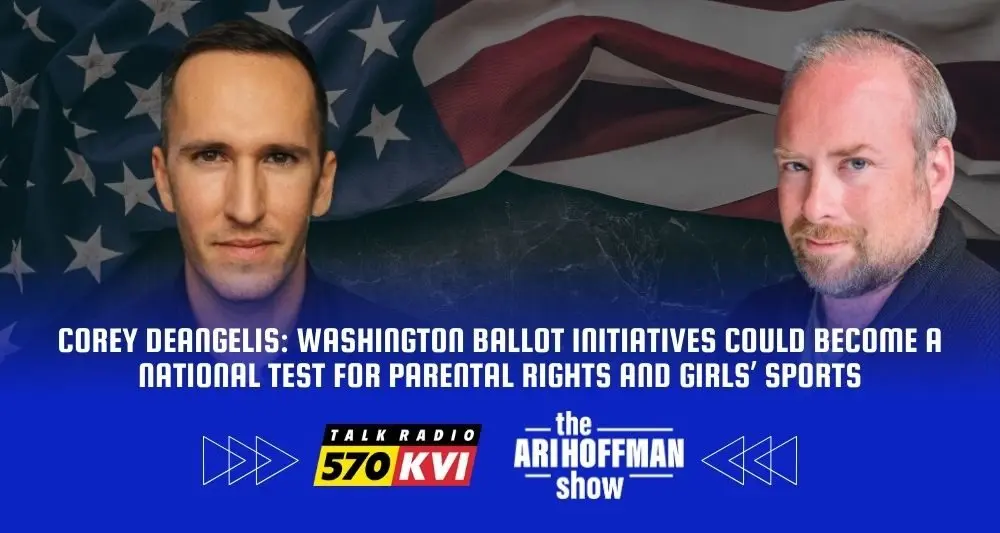
On The Ari Hoffman Show on Talk Radio 570 KVI, school choice advocate Corey DeAngelis said the measures represent a major political moment for a “deep blue” state—and could have ripple effects far beyond Washington.
“This is the test case of whether we can have sanity on the ballot in November.”
School choice advocate Corey DeAngelis weighs in on the Let's Go Washington initiatives to restore parental rights in education & protect girls' sports pic.twitter.com/rLsWlwgwxA
— Ari Hoffman (@thehoffather) February 18, 2026
“I got one of the saddest emails ever this morning,” host Ari Hoffman said, describing a message from a parent keeping a daughter home from school out of concern about walkout-related disorder. Hoffman cited incidents that have drawn attention in Washington, including thefts from convenience stores and assaults reportedly connected to the demonstrations.
The interview came amid growing public debate over student walkouts, school discipline, and the role of political activism in public education. It also coincided with heightened scrutiny surrounding policies on gender identity in youth sports and school settings—especially after a high-profile case reported by conservative journalist Brandi Kruse, which Hoffman noted is now tied to a federal Department of Education investigation.
“Eighty-twenty issues” in a deep blue state
DeAngelis, who recently wrote about the initiatives in a Wall Street Journal op-ed, argued the measures’ strongest political feature is broad popular appeal.
“It’s big news because you’re in a deep blue state… and you get these eighty-twenty issues that have the opportunity to go before the voters,” DeAngelis said, crediting Let’s Go Washington for collecting well beyond the required signatures for each initiative.
The proposals are designed to do two things:
- Protect girls’ sports by limiting female athletic categories to biological females; and
- Restore parental rights and transparency in public schools.
He identified organized opposition—particularly teachers unions—as the most significant obstacle.
“Obviously, the main opponent is the teachers union,” he said, pointing to public comments by Washington Education Association leadership that he characterized as hostile to petition-gathering efforts.
DeAngelis framed Washington as a proving ground: if these measures can pass here, he argued, similar campaigns could gain momentum in states like California and New York.
“This is the test case of whether we can have sanity on the ballot in November,” he said.
Supreme Court cases and the broader girls’ sports fight
DeAngelis also suggested court momentum may be moving in favor of sex-based athletic protections, referencing Supreme Court cases “percolating” on the issue.
He argued that preserving women’s athletics is a civil rights question that the country already confronted decades ago, and should not be relitigated now.
“It’s really crazy to me that we’re having this fight all over again that they had the nineteen seventies to make sure they’re protecting women’s sports,” he said.
Hoffman agreed, describing a reversal in political alignments.
“And now things have totally been turned around where the left just says… we wanna destroy women’s sports,” Hoffman said, arguing conservatives are now the ones pressing to defend female athletics.
DeAngelis emphasized practical impacts he says are being overlooked—scholarships, safety, and privacy.
“Girls need to be protected. Their private spaces need to be protected,” he said.
Walkouts, activism, and school safety
The conversation then turned to student walkouts and what both men described as a broader culture of political mobilization within public schools.
Hoffman said he has seen activism training reach younger students, recounting a video shared by a family member that he said showed grade-school children being guided through participation in a prior walkout demonstration.
“It was just let’s teach these kids to protest,” Hoffman said, adding that he believes similar dynamics are now playing out statewide.
DeAngelis argued the current wave of anti-ICE protests did not originate organically at the school level.
“All these anti ICE walkouts, they didn’t percolate out of nowhere,” he said, blaming the National Education Association for encouraging protest activity and for adopting resolutions he described as unrelated to academic priorities.
He criticized union leadership for what he framed as politicizing classrooms and normalizing disruptions to instructional time.
“Kids can go and wear the shirts that they want and voice their opinions, but the schools are there and we pay for these schools to educate kids, not to turn them into little activists,” he said.
DeAngelis also suggested the response by school officials—described in the interview as permissive—creates legal risk when student safety is compromised.
“A parent saying… my kid’s not safe… I think I have a case to sue you guys,” he said, adding that selective enforcement could raise questions about viewpoint discrimination.
A school-choice “escape valve,” and a political challenge for the governor
DeAngelis argued that one of the most immediate policy levers in Washington is whether the governor opts into what he called President Trump’s new nationwide school choice program, described in the interview as a federal tax credit scholarship initiative.
He said “27 other states” have opted in, and singled out Colorado Gov. Jared Polis, a Democrat, for joining—calling it evidence the idea can cross party lines.
“The catch is that your kids in your state can only receive those scholarships if your governor decides to opt in,” DeAngelis said. “So it’s solely in the hands of governor Bob Ferguson right now.”
He added a political critique of Ferguson’s personal schooling background, arguing leaders should not “pull up the ladder” by limiting options for families who want alternatives to public schools.
“This would give an escape valve for parents to get away from schools that are crazy activist grounds,” DeAngelis said.
Lawmakers and excused absences for protests
Near the end of the segment, DeAngelis pointed to proposed legislation he said would make protest-related absences excused—presenting it as another example of political favoritism inside the school system.
“Lawmakers in Washington… introduced the bill to make these excused absences for protesting students,” he said.
Hoffman closed with a quip aimed at what he views as inconsistent standards.
“Yep. You can walk out for ICE, but not to go to the Seahawks parade,” he said.
What happens next
With the initiatives gaining attention and school protest activity continuing to generate controversy, DeAngelis argued Washington is becoming a national focal point in the fight over education governance, parental authority, and the boundaries of political activism on school grounds.
Hoffman agreed, suggesting the intensity of the backlash reflects political vulnerability.
“I think we’re starting to see the cracks,” he said. “There’s nothing more dangerous than a wounded animal.”