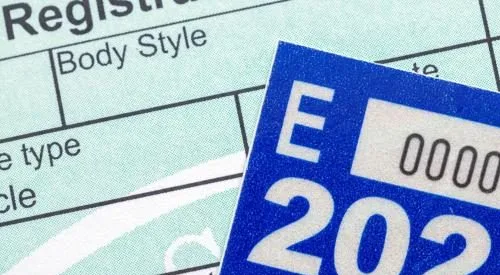
Washington state’s escalating car tab fees—driven in part by charges tied to Sound Transit’s RTA (Regional Transit Authority) taxes and the region’s expanding light rail system—are pushing a growing number of residents to opt out of registration altogether.
NEW: After lawmakers find out Washingtonians aren't paying to register their cars because the fees are insane, lawmakers in Olympia are threatening to fine you, throw you in jail, and impound your car, so money keeps flowing to their light rail boondoggle pic.twitter.com/ExwCOZnpu2
— Ari Hoffman (@thehoffather) January 27, 2026
Last year, it was revealed that an estimated 600,000 people were driving in Washington with expired tabs, translating to a minimum of $25.6 million in lost revenue even using the state’s lowest base fee of $43.25 per vehicle. Fewer drivers are paying the base rate once value-based charges and local transit taxes are layered on because for many households, the math no longer adds up—an outcome that mirrors the Laffer Curve theory, which suggests that raising taxes beyond a certain point can actually reduce revenue by encouraging noncompliance.
NEW: WA Sen Marko Liias (D) is proposing SB 6176: The “pay your tabs or else” bill, which slaps $529 fines on unregistered cars, tickets parked vehicles with expired tabs & threatens out-of-state registrations with jail time
This, after over 600,000 WA residents stopped paying… pic.twitter.com/q5uk4MIeIv
— Ari Hoffman (@thehoffather) January 26, 2026
That growing resistance forms the backdrop for Senate Bill 6176 (SB 6176), sponsored by Sen. Marko Liias (D) and Senator Curtis King (R), which would significantly expand enforcement powers. The bill allows the state and local jurisdictions to cite vehicles for expired registration even when they are not being driven, while also reaffirming severe criminal penalties for Washington residents who attempt to avoid car-tab taxes by registering their vehicles out of state.
Under SB 6176, a new traffic infraction would be created for vehicles with expired registration that are “parked, standing, and unoccupied” on public streets, on publicly owned property, or in certain privately owned off-street paid parking facilities. In the case of private paid parking, enforcement would only be allowed if the property owner consents and drivers are given clear notice. The citation would be issued to the registered owner, would not appear on a driving record, and would be treated procedurally like a parking ticket rather than a moving violation.
The fines associated with this new parked-vehicle infraction are substantial. A vehicle that is two months or less past its registration would be subject to a $145 fine, while a vehicle expired for more than two months would face a $248 fine. The practical effect is that expired tabs would no longer be a risk only when a driver is pulled over; simply leaving a vehicle parked in many common locations could now trigger a citation.
The bill also preserves existing authority allowing law enforcement to impound a vehicle that has been parked on a public street with expired registration for more than 45 days.
Beyond parking enforcement, SB 6176 also draws a hard line against residents who register vehicles in other states to avoid Washington taxes and licensing fees. The bill classifies this conduct as a gross misdemeanor. For a first offense, it authorizes up to 364 days in jail, along with mandatory financial penalties that cannot be suspended or reduced. Those penalties include a required payment of $529, an additional $1,000 fine, and full payment of any delinquent taxes and fees owed to Washington.
Penalties escalate sharply for repeat offenses. A second or subsequent conviction again allows for up to 364 days in jail, requires another mandatory $529 payment, and increases the additional fine to $5,000, on top of all unpaid taxes and fees. The structure makes clear that lawmakers view out-of-state registration not as a paperwork violation, but as intentional tax evasion deserving of criminal punishment.
Voters previously approved a $30 car-tab cap through Initiative 976, only to see it struck down by the Washington State Supreme Court.