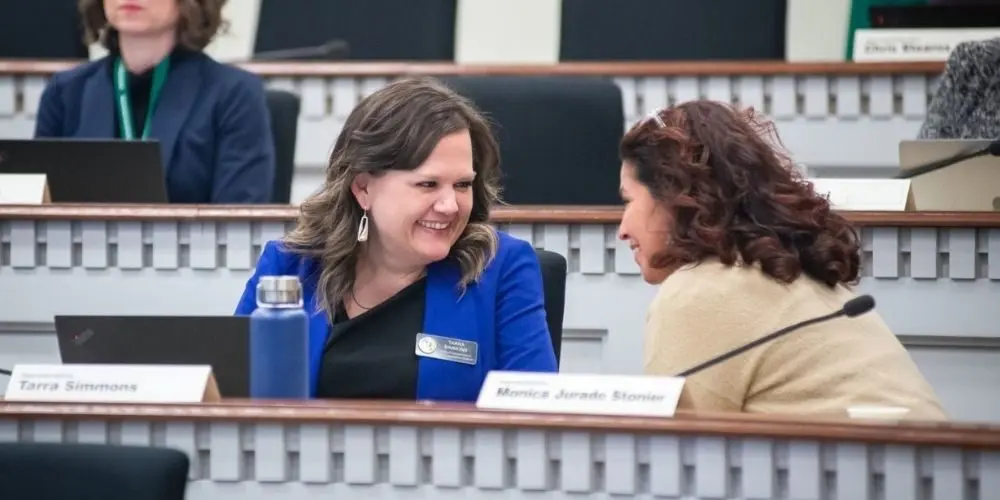
Kitsap County Democrats have seemingly turned on one of their own by filing a formal complaint with the Public Disclosure Commission, urging state regulators to investigate Rep. Tarra Simmons’ campaign-surplus spending, including $30,000 in payments to a Nevada nonprofit made shortly after a trip to Las Vegas.
The Chair of the Kitsap County Democrats, Val Torrens, filed the complaint asking regulators to review Simmons’ handling of surplus campaign funds, arguing the public has a right to know whether political donations were used in a way consistent with Washington’s rules and expectations, and calls for “appropriate action.”
Two $15,000 payments to an out-of-state nonprofit
At the center of the complaint are two $15,000 disbursements, $30,000 total, from Simmons’ surplus account to a Nevada nonprofit, Better Minds Better Communities, in the summer of 2025.
According to the complaint’s supporting material, the size and destination of the payments stand out because Simmons’ past surplus spending allegedly went mainly to Washington-based nonprofits and typically in smaller amounts. The complaint argues these two transfers represent a sharp break from that pattern and asks regulators to examine what justified the out-of-state gifts, how the recipient was chosen, and whether the spending complied with the rules governing surplus funds.
Torrens wrote in the complaint, “Representative Simmons has made two donations of $15,000 in July and August of 2025 to Better Minds Better Communities, which have no public records describing the organization and who is responsible for it or who is the recipient of these monies.”
The complaint packet also points to what it calls “red flags” about the nonprofit’s public footprint and leadership, raising questions it says warrant review.
The Jovan Jackson connection and Las Vegas trip timeline
In its supporting documentation, the complaint highlights the nonprofit’s purported leadership ties to Jovan Jackson, described in the complaint packet as a sitting member of the Nevada State Legislature.
The complaint’s attachment states that IRS paperwork for Better Minds Better Communities lists Jovan Jackson as the organization’s primary contact and a director, along with John Jackson, and that both list the same address, which appears on Simmons’ campaign finance filings for the two surplus-fund disbursements.
The complaint further argues that the timing of the payments “sharpens the need for review.” It claims publicly available social media content indicates Simmons had a standing relationship with Jovan Jackson and that she traveled to Las Vegas in June 2025. The complaint notes that within roughly 30 to 45 days of that trip, Better Minds Better Communities received the first $15,000 payment. While the complaint acknowledges that timing alone does not prove wrongdoing, it contends it raises questions about how the organization was selected and whether personal or professional relationships influenced the decision.
Why this lands harder: Simmons’ brand is criminal-justice advocacy
Simmons, one of the Legislature’s most visible criminal-justice reform voices, has a background of criminal convictions. Supporters have cast Simmons as a credible messenger on reentry and rehabilitation. Critics, however, argue her legislative priorities consistently tilt toward reducing consequences for offenders.
A trail of bills that drew backlash
Simmons’ record includes several proposals that became flashpoints:
Voting rights while incarcerated. In the 2023–24 biennium, Simmons sponsored HB 2030, which would revoke voting rights only when someone is convicted of a state crime punishable by death.
Sex offender policy board changes. Simmons also sponsored HB 2177 (2023–24), addressing the “membership and operation of the sex offender policy board” to include people with sex offense histories alongside victims and other representatives.
Judicial discretion to modify sentences. In the current biennium, the Legislature is considering HB 1125 (2025–26), “providing judicial discretion to modify sentences in the interest of justice.” Simmons has been associated with broader efforts to expand avenues for sentence modification, an approach opponents say risks second-guessing final sentences long after a case is resolved.
Drive-by shooting penalty debate. Simmons was a prime sponsor of HB 1692 (2021–22), a bill explicitly framed around “promoting racial equity” that would eliminate drive-by shooting as a basis for elevating first-degree murder to aggravated first-degree murder. The proposal drew criticism for being perceived as reducing consequences connected to drive-by shootings, even as supporters argued it addressed inequities in how enhancements are applied.
In 2024, Simmons was ousted from a criminal justice nonprofit she founded after allegedly having been criticized for being too “white-presenting” to lead the organization.
An intraparty rupture in a safe-blue district
Complaints like this often come from partisan opponents. This one is politically explosive because it comes from inside the Democratic orbit in Kitsap County—turning what might have remained a private dispute into an official allegation that can shadow Simmons through endorsements, fundraising, and intra-party influence.
What happens next
The complaint asks regulators to evaluate whether Simmons’ surplus-fund disbursements complied with Washington’s campaign-finance rules and whether the circumstances around the Nevada payments warrant enforcement action.
Simmons’ office told The Ari Hoffman Show on Talk Radio 570 KVI in a statement, “I am concerned the complaints are motivated by a narrow political interest, so I have proactively reached out to the PDC to offer any information needed to resolve this as soon as possible while I focus on delivering for the people of my district during the session.”