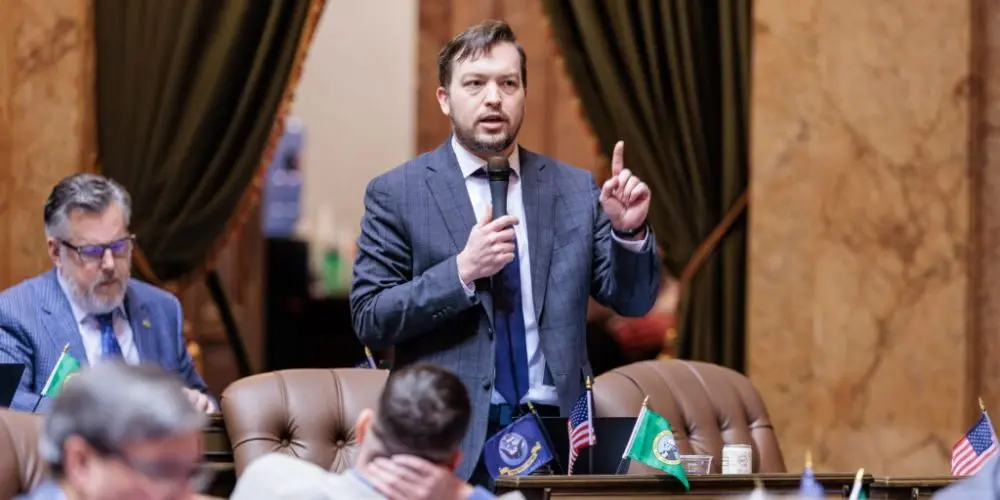
Washington State Sen. Leonard Christian (R–Spokane Valley) has pre-filed legislation that would treat “paid protestor” labor the same way Washington treats other temporary staffing, subjecting it to the state’s retail sales and use taxes. The bill, Senate Bill 5819, was pre-filed on December 1, 2025, ahead of the 2026 regular session.
Christian told the Ari Hoffman Show on Talk Radio 570 KVI that the bill was his way of “doing my part to… balance the budget.”
Washington State Senator pre-files legislation that would subject “paid protestor” labor to the state’s retail sales and use taxes.
Sen. Leonard Christian (R–Spokane Valley) said the bill was his way of “doing my part to… balance the budget.” pic.twitter.com/qKnfm01eOc
— Ari Hoffman (@thehoffather) December 3, 2025
The bill: protest labor folded into “temporary staffing services.”
SB 5819 would amend Washington’s definition of “sale at retail” in RCW 82.04.050 by expanding the meaning of “temporary staffing services.” Under the bill, temporary staffing would explicitly include “providing workers as paid protestors… to supplement or support a public protest on a contract or for a fee basis.” That classification matters because retail sales in Washington are generally subject to the state’s sales and use tax framework.
AWESOME. Washington State Senator Leonard Christian (R) just pre-filed a bill that would carve out a special tax for people who hire paid protesters. LMAOOOOO. pic.twitter.com/6e1HGj8XE6
— Brandi Kruse (@BrandiKruse) December 2, 2025
In other words, if an entity hires a company to supply workers for a public protest, the transaction would be treated like other taxable staffing services—similar, Christian argued, to how certain specialized contracted services have recently been taxed when used by schools and other employers.
What sparked it: “Who has time to be out there all day?”
Christian told Hoffman that the idea began after he watched commentary about recurring protest activity and started asking a practical question: how do people afford to spend weekday after weekday demonstrating?
“I don’t have the time to sit out on the street and protest,” he said. “So, what’s the deal behind this?”
Earlier this year, The New York Post reported that “dark money” megadonors helped fund groups organizing protests in Washington, DC, opposing President Trump’s crime and immigration crackdown policies.
Financial documents obtained by the outlet showed more than $20 million flowing to the entities linked to these efforts, listing donors and donor networks such as Open Society Foundations, linked to George Soros, Tides Foundation, and others.
In August, Adam Swart, CEO of Crowds on Demand, told Fox News that service requests in DC from May to July 2024 jumped roughly 400 percent compared to the same period last year. The company, which supplies participants for political rallies, protests, and advocacy events, says such surges typically occur during “high-stakes political moments.”
Christian said the thought for the legislation crystallized after hearing from schools that were feeling the pinch of taxes when contracting for specialized staffing, like nurses or speech therapists, prompting him to wonder why a protest-related staffing arrangement would be treated differently.
His stated aim: force a political choice (and spark debate)
Christian was blunt that the bill is designed to highlight what he sees as selective tax policy. During the interview, he framed it as a way to put the majority of Democrats in an uncomfortable spot: support a tax that hits protest-related labor or concede they’re willing to tax traditional jobs and services while declining to tax protest-related contracting.
“This bill is all about… the fact that they’re willing to very specifically target folks who are just showing up to work… But when it comes to the crazies, they’re certainly not willing to tax them,” he said, adding that it would make lawmakers choose between “worse or worse.”
Hoffman pressed the political strategy further, suggesting the bill could be used as a messaging tool to argue “hypocrisy,” and floated the idea of pursuing an initiative campaign if the bill doesn’t receive a hearing.
Christian replied that it was “a great idea,” and said skeptics had told him “there’s no such thing as… paid protesters,” to which he quipped: “Let the department of finance figure it out. If there’s money to be made, they’re gonna find it.”
Will it pass? Even a friendly Democrat predicted “it’s going nowhere.”
Christian acknowledged the reality of Olympia math. Washington Democrats control both chambers, and Christian recounted a conversation during which he described that a Democratic colleague laughed and told him the bill was “going nowhere.”
Still, Christian and Hoffman treated the measure as a vehicle to shape the broader narrative heading into what they both described as a difficult budget year and a contentious session.
Session outlook: “They are gonna scramble… to get an income tax.”
In the final minutes of the interview, Christian widened the lens beyond SB 5819. He said he expects a “really challenging session,” arguing that revenue assumptions are tighter than anticipated and that lawsuits have created consequences the state now has to manage.
“I don’t think that the money is there that they thought it was,” he said. “They are gonna scramble their hardest to get an income tax.”